In Scotland Again - Bunree, Loch Linnhe to Loch Duich and Morvich: Episode 4

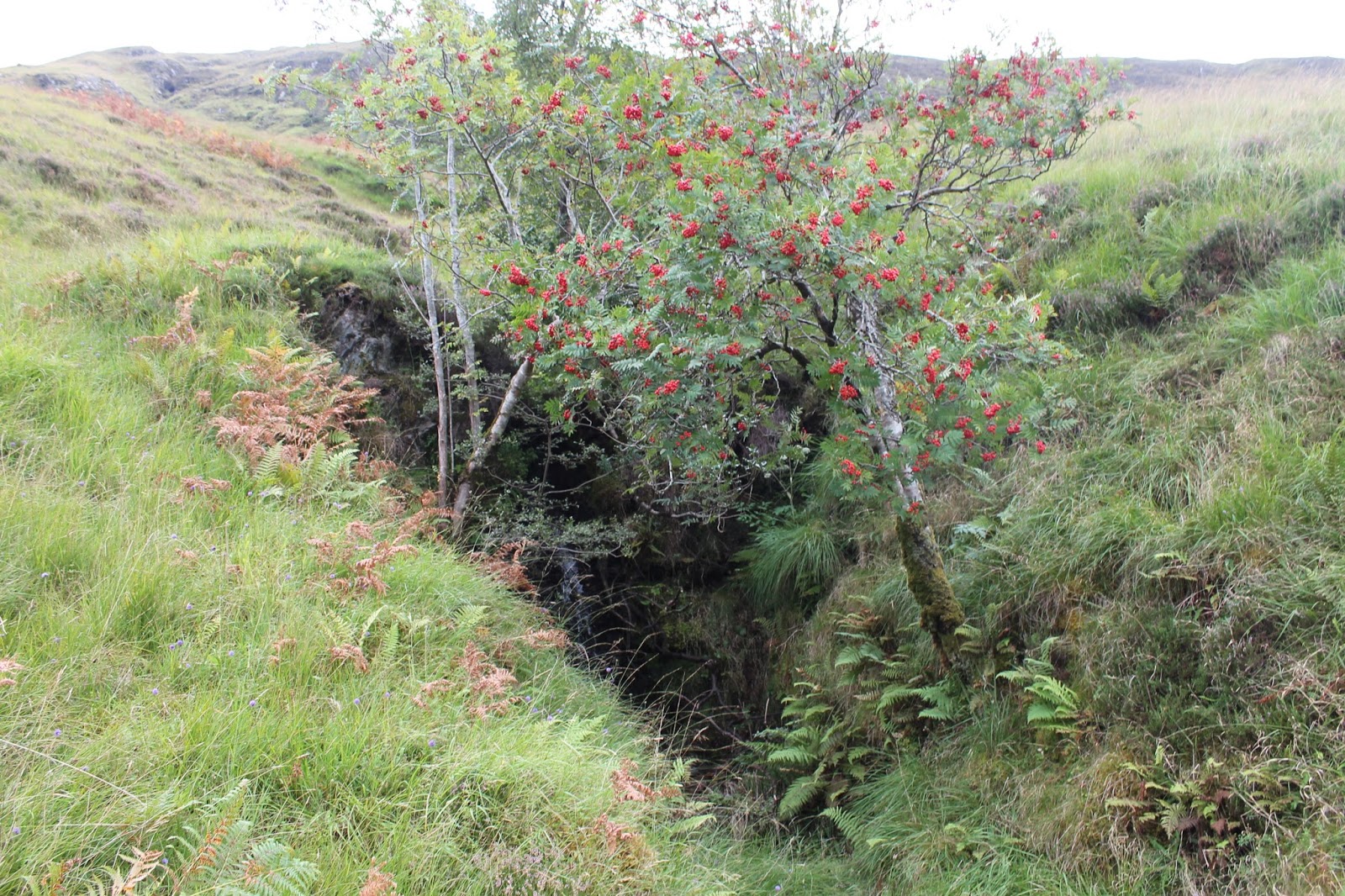
Whilst HV Morton, on his 1933 trip, forges ahead in his bull-nosed Morris to Fort William and the Mod, we are resting back at Bunree, looking out over the bay at stunning sunsets. September has gathered pace, 'the Rowan berries are red as the blood in Glen Spean', and the bracken russet brown.

Henry Morton's observations of the drama of the Highlands is so real here. One moment huge grey clouds race from the west into the bay and rain lashes against the camper roof, the next, sun lights and warms the craggy landscape as 'a day of atonement'.

Today is one of the atoning days, and we thread our way to the Corran ferry, just under half a mile from the site. Taking the little track from the roadside path to the ferry point, we arrive just as the boat moors across the narrowest point of Loch Linnhe at Ardgour. As the cars and vans arrive to queue, we feel almost intrepid as free foot passengers, and are waved on first by the crew.


Take the high shelf on the boat to enjoy the view and feel the wind. The crossing takes but four minutes or so, departure and arrival assisted by hydraulics rather than 1930's rough ropes. But nevertheless, it is still a ritual. The cars are stacked so that barely a crisp packet could be placed between their bumpers. Drivers, new to the ferry, look anxious, whilst the regular travellers spin their vehicles into place. The doctor's Mercedes is given a place at the front for quick get-away, whilst butcher's van holds back to fill an awkward slot across the deck. Did a siren sound? Morning sunshine glints on a computer screen in the wheelhouse. We slip across the smooth loch.


Disembarking at the Inn of Ardgour, we are indeed back in Morton's 1930's. When the noise of engines has subsided, there is nothing left but the breeze lifting across the crofts cluttering the bay. We stroll north past the parish church, designed and built by Thomas Telford, to take a sharp left turn up the lane and into the woods towards Lochan na h Eaglais, a perfect lake rimmed with silver.
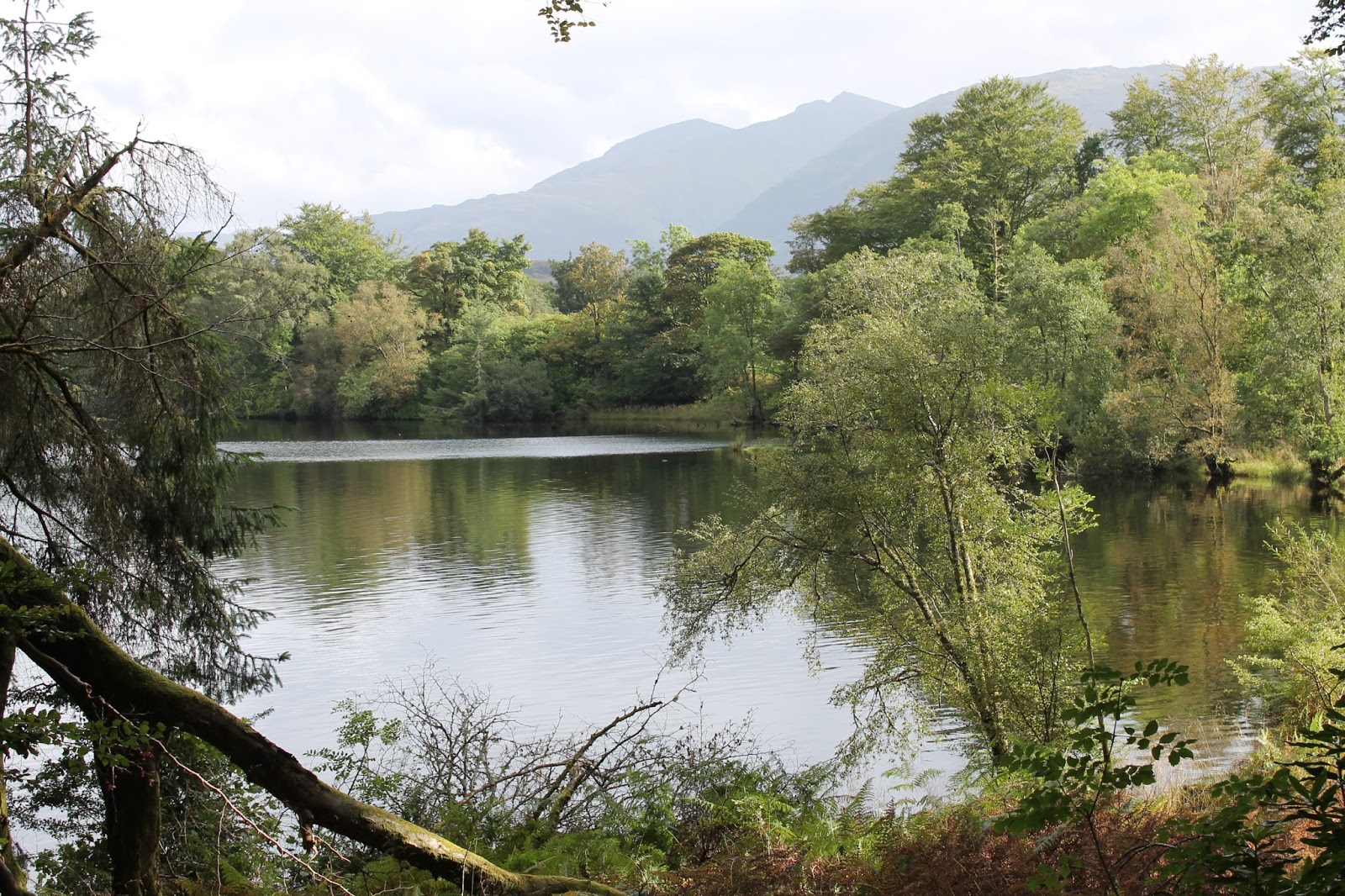
If time forgot, it forgot this place. Here we dip down to the lakeside to sit in silence. A carp plops beneath overhanging branches and finches nibble the seeds of reeds. Otherwise, it is totally still -even the breeze that blew on Linnhe has evapourated in stillness.


The track takes us round to the crofting community of Clovullin and its village shop where a purchase, however small, must be made. From there, the road leads back to Corran lighthouse and the ferry home.


Two days seep into four before we resume Morton's route. Leaving Bunree, we travel north to Fort William, stopping not for the ceilidh but for provisions and fuel at Morrisons; and at Invergarry, we head west on the A87 past Loch Garry towards Lochs Layne and Cluanie - eventually to reach Shiel Bridge and Loch Duich where the leaves are turning 'blood-red and plum-yellow'.

On our route we meet again with H V Morton at chapter 7 section 3 of 'In Scotland Again'. The road, running alongside 'the roof of the highlands' is a delight, with mile after mile of wilderness tamed only by the Cluani Inn.

Beyond at Mam Rattachan before Glenelg, Morton observed 'As the light was drawn from the sky the mountains became grape-blue. Grey mists crept through the valleys; dark mists were hung from gorge to gorge high up in the wilderness of the hills. Above, the first star burned; and the mountains settled into silence and the dark'. 

We are on 'the road to the isles' and our way to Morvich.

In Scotland Again - Morvich, Kyle of Lochalsh, the Isle of Skye and Talisker: Episode 5

Morvich camping site lies to the east of the A87 in a drowsy, sunlit valley by the river Croe, peering up to Dorusaduain and overlooked by Lienassie.

This is yet another place of joy, back from the loch, but enjoying long views towards Duich.

Here, we caught up again with H V Morton on his 1933 trip, and had hoped to meet his friend Sir John (or his heirs). They clearly had already departed up the valley, so as 'In Scotland Again' at chapter 7 section 6, we decided to venture towards Beinn Fhada in search of our own Red Deer, armed in our case only with a camera.

The walk leaves Morvich towards Loch Duich, but turns sharply north to cross the Croe as if heading on the back route to the A87, then turning east passing the bed and breakfast lodge up the valley into the forest and the hills.


Chapter 7 contains one of Morton's reddish-brown sepia prints. A glance will tell you that, on our way, we found the same herd, spooked as we know by Sir John's sheep, and now gathered attentively below the trees on the other side of the valley awaiting our photo. 
The return route of the walk takes you down from the forest, crossing Abhiann Chonaig at the little footbridge constructed by the Royal Engineers, and back through the fells.

The walk is one of magic. Take a flask, a sandwich, a mat and binoculars. Climb the slope, sit in the bracken and heather and listen to the wind. Then look out for the eagle.

Skye bridge rises from Dornie on Loch Long, just to the north of Eilean Donan Castle. At this point we again leave 'In Scotland Again' to join H V Morton three years earlier in 1929 in chapter nine of 'In Search of Scotland'. You will recall from blog 2 that Robbie of Ayr had tempted me with Talisker, the same as shared with the Highlander Cameron (chapter 10 section 5 of 'In Search of Scotland'). Morton, by his own account, must have acquired his Talisker whilst on Skye as he reported it to be 'that remarkable drink which is made in the Isle of Skye and can be obtained even in its birthplace only with difficulty'

And so to Skye - for Talisker. H V Morton left from Mallaig to the south , taking the 'Stornoway' boat up the Sound of Sleat to Kyle of Lochalsh, where the ferry tied up 'to a a wooden jetty covered with pink sea-anemones', and he transferred to the Skye paddle steamer for destination Portree.

'To me it is pure romance. Some stray old wind from Culloden blew, I think, into my nursery when I was a child, for almost the first stories I heard were stories of Skye and of a brown-eyed prince hiding in a cave'....a place 'shrouded in the splendour of a lost cause'.'The sound of it is like a sword going home into its scabbard'.

But where the ferry? No swishing of a paddle steamer. Ahead the Skye bridge rises, then falls onto Skye, and in but two minutes we have arrived at Kyleakin. 

The road from here to Portree is quick, with none of the highland single track. It is made for trucks, buses and campers. Whilst it coils along the north east coast, the island's mountains remains totally unaffected by it. Dark and brooding, they give a feeling of hopelessness, not bleak, but simply ominous. We leave the A87 at Sligachan, heading west and inland on the A683 to Carbost and the distillery. Park beyond the factory to the right down towards the loch, and once equipped with your bottle of Talisker, why not ascend the hill beyond the distillery to lunch at 'The Oyster Shed'. First appearance is of a seafood farm shop - with a fish van outside. Be not fooled! This is the most perfect place to order and eat the widest range of locally sourced fish - especially shell fish, lobster, crab, prawns and scallops. Place your order at the shop counter and wait for your number to be called. Then head round the side to 'the shed' - an open fronted communal eatery with panoramic views over Skye - to devour your choice. The fish is so fresh you can almost feel it breathe. Flavour-packed and perfectly cooked, this provides a true taste of the isle. Take a side order of chips - now this is how chips should taste - and maybe crack open that bottle of Port Ruighe that you have just bought. 

Unlike Morton, who spent time at Portree, packing by candle-light and leaving 'to go down to the jetty where the 'Glencoe' lies, her riding-lights growing pale in the grey dawn', we leave in the evening, crossing the Skye bridge as the sun sets, and the gloom gathers. 

Tomorrow we will head out to Kinlochewe. 
Thanks to the Herald Scotalnd for the pic


In Scotland Again - Kinlochewe and Achiltibue: Episode 6 - final

Leaving Morvich by the back road, we catch the A87 west bound towards Eilean Donan Castle crossing Loch Long at Dornie. At Auchtertyre we branch north on the A890 heading for Achmore and Stromeferry. The road then hugs the loch side until you reach Achintee. From there, the A890 rises north east to Achnasheen, with a west spur on the A832 to Kinlochewe.

Our H V Morton friends will recall that, 'In Scotland Again' Henry headed east to Inverness, and in his less adventurous first journey 'In Search of Scotland', he descended from Fort Augustus to Fort William before venturing out to the western coast and to Skye. Times were different in 1933, and unless roads led to ferries, there was little point in pursuing them to the handful of crofts at the road end.

So we are leaving Morton to his inland journey. But we will retain his spirit of travel, to observe his Scottish wilderness through 21st century eyes; and just as he left his bull-nosed Morris behind, will leave the Auto Trail to walk and share the special Allt a' Chuirn path towards A'Chreag Dhubh.

We camp at Kinlochewe, a gentle site that rests below the Beinn Eighe National Nature Reserve. Our pitch collects the stream's gentle gurgle. After the mountain roads and tight bends, here is an oasis of calm. Even the nearby reserve has a soft, forested aspect to it with quiet walks on zig-zag stoned paths to the visitor's centre.


Just round from the site on the Torridon Road, Kinlochewe old village hall had probably seen better days before Lis Broome and her pose of helpers arrived to rescue the corrugated iron shed from the scrapman and turn it into The Whistle Stop Café, a vernacular place with oodles of charm and even better food. We visit before taking to the hills, and we are not alone.

Of the many Highland delights, The Whistle Stop Café's must rate as the best big breakfast. Joining Tom and Wendy, two young and intrepid walkers who were to cross the 1010 metres of Beinn Eighe and travel through 20 miles of heather tracks, Stephanie and I hunker down to the feast. This is the meal about which Morton dreamed in chapter 1 section 5 of 'In Scotland Again'.

Our journey is less ambitious. We aimed to walk the Allt a' Chuirn path west from the reserve towards the rugged, rocky Beinn Eighe, rising evenly by tracking the stream that cascades down to the A' Ghairbhe fed from Loch Clair. 


This is a truly magical walk, suitable for the averagely fit walker with three hours or so to spare. If the weather is kind, it is not to be taken at a trot, but savoured slowly with rests in the heather and long views through the valley.

 At the head of the valley where it departs into open, rugged terrain, stop at the waterfall. If the day is hot, drop down to the pool and bathe tired feet. We return down the valley in late afternoon sunshine. There is a sadness about leaving the solitude of the fells for the populated village below, but solace in anticipation of our barbecued 'born in Scotland', 'reared in Scotland', ear-tagged rib eye steak, pre-ordered from Allan at Kenneth Morrison, the camp site's visiting butcher (01445712485). 

Two days later, we head out for our final destination, Achiltibue, or more precisely, Port a Bhaigh campsite at Altandhu.


For Port A Bhaigh you must leave the A835 south of Drumrunie turning sharply out to the west 12 miles on on the narrowest single track road. The unnamed road traverses the north side of small lochs giving views into rugged low lying West Highland countryside. A measure of the terrain - you will need 45 minutes to complete the 12 miles, but using the passing places for moments to collect, we feel the journey as part of the experience. Port A Bhaigh campsite sits on a small bay, protected to the west by Isle Ristol and Eilean Mulagrach, the first of the Summer Islands, their low turf and heather clad moorland rimmed by cream rock shores.

The view is ‘heart-felt’ rather than breath-taking, but it has an intimacy that says you belong here. Ascend the hill to the owner’s pub. With friendly bar and dining room serving snacks and main evening meals, it has a convivial atmosphere. Make the most of it for, to the north, the nearest next pub is in Iceland. Walk the road to Reiff, offering headland views from the coastal path beyond, or hire kayaks for an escorted trip around the islands.


Henry Vollam Morton is still travelling as we return down to Inverness.
Like him, we found that the Highlands seeps into your soul. Gone, or rare, the Gaelic - no more the wood smoked hotel lounges with visiting 
salesmen and khaki-clad maidens. The ferries now pull with diesel engines rather than paddles. 

But the mountains remain solid and permanent, and the Golden Eagle still soars above. 


Festival Campervanning


Taking time to tour is tempting, but flitting the festivals - altogether another delight. This year, Stephanie and I have been festivaling in the motorhome, and this is what we found.

Readers will know that with the departure of the CI Mizar after 20 years, and the arrival of the Autotrail Tracker, our touring has increased exponentially. Gone - the overhead bunk, tight dinettes, and marine toilet, now - a fixed bed, superb lounging and cassette loo. Modern motorhomes are indeed 'home-from-home', proving all of those little extras that make a trip easy and fun.

Britain's choice of festivals is vast. Music, theatre, crafts, sports, racing, nature, retro, cookery, food are just a few. A quick web search opens up a host of activities and interests - each one offering its own community of followers, and potentially, new friends with similar interests.

Stephanie and I are tango dancers - more particularly (because there is a vast difference), Argentine tangueros. Our obsession with tango takes us around the world to dance and conquer the continents, especially South America. But here in the UK we still have opportunities to dance at national and international festivals arranged throughout the year.

So, what of 2016 so far?

We started in May with the annual Edinburgh International Tango Festival, and for it we chose to stay on the Caravan Club site at Marine Drive by the Forth estuary waterfront. Although a 10 minute walk to public transport, the site is restfully located to the north of the city with easy access by bus, and late night return by taxi. Driving in Edinburgh is not for the feint hearted, and caravanners may choose to leave their cars for once, after all, this is a trip and you are on holiday.

The benefit of the motorhome soon became apparent when it came to managing a festival. Suitcases are one thing, but a motorhome is quite another dimension. Whatever the activity, a quantity of kit is required and subject to weight limits, a camper is the answer. Here you have room for all the clothes, food for the trip, the surf board, the golf clubs and the barbecue.

Our next trip was a tango festival in Cheltenham at the end of June. This was our second visit, so we had no doubt that Cheltenham Racecourse was the place to stay, right on the edge of the park and ride, but set in an astonishing setting surrounded by gorgeous views into Gloucestershire.

Cheltenham is a centre for numerous festivals, including the Literature Festival, Jazz Festival, Science Festival, Music Festival, Food and Drink Festival and, of course, the famous Gold Cup held on site. The town is within walking distance, so there is absolutely no need to drive. If you do visit, remember to take your leveling blocks.

We now await Twinwood, arguably Britain's top retro music and dance festival. The event is held annually at the old aerodrome in Clapham Bedfordshire, famed for being the RAF airfield from which in December 1944 Glenn Miller made his last flight before his plane simply disappeared from the world. These days at Twinwood nobody disappears. Quite the contrary, larger than life, hundreds of visitors dress for the occasion to celebrate the 1940/50's in style, to listen to the bands and to dance.

Perhaps now is the time for you to consider life outside the camp site, and the possibility of new interests, activities and experiences? For us it has been a joy. What is stopping you?


2016 - New Season starts in snowy Wharfedale


The Auto Trail Tracker FB has opened the opportunity to travel out-of-season. Whilst I used my previous motorhome - a 1994 CI Mizar - during the winter, trips were short, sharp and challenging. Now with the luxury of the Tracker, things are very different.

With this blog entry, I will be addressing winter travelling, with tips and remedies.

Those who have read previous entries here will be familiar with the Auto Trail Tracker FB - a motorhome 'for two-to-travel', with fixed double bed (hence the FB tag). The Caravan Club Wharfedale site provided mains electric hook-up to each pitch. Without this, I sense that winter motorhoming for any significant stay would be too demanding.

Regular readers will also know that as an extra, I had a Gaslow refillable autogas system fitted to the vehicle. Refillable gas delivery comprises a principal gas bottle, linked to a smaller 'spare', the whole system being remotely filled or topped up at an autogas service station via an externally mounted filler, similar to those found on LPG powered cars. Gas is then delivered via the regulator on demand to the heating, refrigeration and cooking appliances (when not programmed to operate on mains electric).

For winter motorhoming, a refillable gas system is imperative, avoiding the calamity of bottles running dangerously low - to be replaced by expensive cylinders from sites and far-flung suppliers. Cheaper gas means that the heating can be set affordably to electric/gas mix for the initial temperature boost. Simply programme the setting at the control board, set the thermostat in the mid 20's and the heating fan on the high setting. As the temperature rises, seize the moment to revert to mains electric and a more modest temperature setting.

The header photograph to this entry reveals a second 'must-have' for the winter motorhomer. Reflective screens provide insulation in both summer and winter; but at this time of year they are essential not just for temperature but for condensation.

After examining the options and trawling the motorhome owner sites, I settled on Taylormade as a supplier. Significantly, the company is operated by motorhome owners that know what is needed, and have incorporated their know-how into the finished product. Robust and well made, the screen cover has the added advantage of length, covering the engine compartment air vents. It also comes with a fold down centre panel, opening with simple Velcro fastening at each side. 

With the cover fitted, for the first time in out-of-season motorhoming, we suffered no condensation, and the cab which is incorporated into the sitting area in the FB, became useable. Whilst on site we kept the screen cover in place, but rolled down the centre panel for daylight, closing at dusk.

When ordering the screen cover, I decided to invest in a Talormade bonnet cover for a modest additional charge. Whilst this proved to be slightly more fiddly to fit (mainly due to an absence of application to the fitting instructions on my part), it certainly made a difference to the ingress of cold air which is a feature of the Fiat cab. Unlike the screens, the  bonnet cover is not insulated, so takes little packing space making it a simple but effective extra.

Whilst dealing with the question of temperature control whilst pitched, don't forget to close the blown air points inside the cab. Without a running engine, these simply admit cold air and drafts.

Finally, the issue of sleeping. When Stephanie returned last autumn with a Winceyette bottom sheet, high-tog duvet and a throw, I wondered when on earth these would be used. Well, the answer is - as soon as you commit to out-of-season travelling. Night time may be the most challenging time in a motorhome. Economy and ecology suggest that the heating should be turned to a lower setting, and indeed this is better for comfort. But the addition of great bedding is a luxury not to be ignored. 

With these simple, positive steps, winter motorhoming is not just possible, but pleasurable. It opens a further opportunity to get the best use out of your van and to experience a winter break with a difference!


How heavy are you?


One of the most neglected / least discussed issues is that of your motorhome's payload. 

Auto Trail Tracker FB's leave the factory with mass in service weight of 3210 kg (the weight after conversion by Auto Trail, including an average weight driver) and an authorised payload of 3500 kg (the total permitted weight) The difference between the two is 290 kg -  to cover a passenger, any extras fitted, and luggage. 

The 3500 kg figure is a compromise - reached by converters to keep the authorised weight in the category of Private Light Goods (PLG), rather than Heavy Goods Vehicle (HGV). This enables those who passed their car test after 01/01/1997 to drive the vehicle on an ordinary car licence. 

For some motorhomers, 3500 kg is sufficient. But for others, not. It took me right to the edge when I weighed the vehicle at a weigh bridge.

Auto Trail provide a most useful payload calculator to assist. Thus, I found that my extras: media pack added 12 kg, solar panel 20 kg, Gaslow system 36 kg, and towbar 70 kg - totalled 138 kg - leaving 152 kg for my passenger Stephanie, motorhome kit, clothing, food and water. Fortunately, Stephanie - as a dancer - is very light and slim!

There are some items which are not really negotiable when it comes to motorhoming, for example, bedding, towels, cutlery, crockery, cooking equipment, food, spare clothing, levelling blocks, mud mats. Other items all add up the weight - some light such as a laptop; others heavier such as a barbecue. 

Concerns about being pulled up by police or revenue inspectors and sent to a weigh bridge are over-stated here in the UK. Most authorities are looking for overladen goods vehicles and not interested in the average motorhome. However, things are a little different in Europe, especially France, making the risk of being over-weight simply not worth taking. 

The Tracker FB (like a number of other models built on the same chassis) is however 'type approved' for the higher Maximum Authorised Weight of 3650 - adding a significant 150 kg, and almost doubling my spare payload. I quickly realised that seeking the upgrade was the way forward. But how to do this? The answer came, most helpfully from Simon Chainey at Tyne Valley Motorhomes, with contact names and addresses at Auto Trail.

So, I thought it would be useful to set out my free, definitive, simple six stage, tried and tested approach, which allowed me to increase my payload in the space of two weeks.

*****

Every Fiat base vehicle leaves the Fiat factory with a metal VIN plate mounted at the front of the engine compartment. This is a Fiat 1st stage plate. It reveals the information about the base Fiat vehicle BEFORE conversion. It is of interest, for it will tell you about the maximum permitted weights for this type of chassis, a combined vehicle and towing weight, and separate figures for each axle. This metal plate will remain unchanged on the vehicle.

The Tracker FB is built on a Fiat Ducato X250 35 'Light' chassis’ - originally homologated by Fiat with a Maximum Authorised Weight of 3650 kg (as shown on the Fiat VIN plate under the bonnet).

At conversion – Auto Trail as multi stage body builder, have ‘Type Approved’ the Tracker FB to both 3500kg and 3650kg. This permits Auto Trail to give their customers a choice - as drivers who passed their car test after 1997 are restricted to 3500 kg. Auto Trail then simply attach their secondary weight label to every vehicle that leaves their factory showing the specified gross weight – usually 3500 kg by default.

Because the model is type approved to either gross weight, it is a simple task to change – either up to 3650 kg or down to 3500 kg – without making any technical alteration to the motorhome.

Do note that, whilst the vehicle remains ‘Class 4 for MOT purposes, the difference in Maximum Authorised Weight changes the vehicle category from Private Light Goods (PLG) to Private Heavy Goods (PHG) with some minor speed restrictions, or French toll charges (if they check). Revenue tax rates change slightly, but importantly, if you have passed your test after 01/01/1997 you will need to upgrade your licence. For those reaching 70 years of age, you have to provide a completed medical report indicating your fitness to drive an HGV https://www.gov.uk/government/uploads/system/uploads/attachment_data/file/369458/D4_160414.pdf

Note that some breakdown recovery policies only cover vehicles up to 3500 kg, so you may need to review this. 

Six stage process
.For convenience, this specimen is for an upgrade from 3500 kg to 3650 kg:
  1. Go to ‘contact us’ on the Auto Trail web site http://www.auto-trail.co.uk/contact-us and send a message to the Technical and Quality Manager, as follows:
“I am (your full name name) the registered keeper of the Auto Trail (model) specified below, currently with a Maximum Authorised Weight of 3500 kg. I seek a letter of confirmation, re-issued Certificate of Conformity and new secondary weight label so that I can re-register the vehicle at 3650 kg.
Vehicle:                       Auto Trail motorhome
Model:                         Tracker FB
Base vehicle:              Fiat Ducato
Chassis no:                 xxxxxxxxxxxx
Reg. no:                      xx xx xxx
1st reg:                         (date)
Specification:              factory standard
  1. Auto Trail will send you a letter, together with the other documents requested. Photocopy the new secondary weight label to send to DVLA, then affix the label over Auto Trail’s original label on your motorhome.
  2. Download, print and complete DVLA form V70 (if already taxed) or V85 (if not currently taxed) using these links V70https://www.gov.uk/government/uploads/system/uploads/attachment_data/file/364271/V70_180914.pdf V85 https://www.gov.uk/government/uploads/system/uploads/attachment_data/file/360106/V85_140714.pdf.
  3. Complete box 7 of your vehicle’s UK Registration Certificate (log book) specifying the new authorised revenue weight and change from Private Light Goods (PLG) to Private HGV or vice versa, sign and date.
  4. Keep photocopies, and send to  To DVLA, Swansea, SA99 1BA
·         Form V70 or V85 (completed)
·         UK Registration Certificate (log book) completing box 7 & 8
·         Letter of Confirmation
·         Certificate of Conformity
·         Photocopy of secondary weight label

  1. Within a few days they will send you a new UK Registration Certificate (log book). Your Certificate of Conformity will be returned to you under separate cover.
Ensure that your UK Registration Certificate shows the new revenue weight at box (Y) and that you store with it the original Certificate of Conformity and Auto Trail letter of Confirmation to support the changes.
Inform your insurers if your vehicle weight is recorded on your insurance documentation, and ensure that your breakdown recovery scheme will recover your vehicle at the higher weight. 

Cosmic June


With a shortened and divided week - Argentine Tango at Voodoo Café falling on Thursday - Stephanie and I decided on a two centre trip.

The first half demands a return to Whitley Bay - for no other reasons than the spectacular view across the North Sea from Old Hartley, and the myriad of walks along the cliffs.

The van is packed. Aware as we are of the payload margin on the Tracker (290kg) from which we deduct our fixed extras (125kg), we take just what we need. The fresh water tank has a capacity of 100 litres. Each litre of water weighs 1kg, so carrying water from home to site is not advisable.

Our route this windy Tuesday takes us across the Tyne Bridge, Newcastle. Traffic issues on the A1 Gateshead are still prominent, and the approach to the bridge is slow, despite our weekday choice. A clear advantage would have been gained from the Tyne Tunnel crossing, even better with a pre-paid permit. From the bridge the 1058 takes us out towards Tynemouth, with a turn north up the A19 to the 190 east-bound route to Seaton Sluice.


The sluice dates back to the mid 17th century, developed by Sir Ralph Delaval to flush silt from Seaton Burn harbour. A century later, Sir John Humphry Delaval used explosives to make a new passage, a 900' long, 54' deep channel for shipping - now providing impressive industrial archaeology for the visitor.

The camp site, as readers will already know from my earlier blog, lies just to the south at the village of Hartley, famed for its historic salt flats. Now all that remains of industry are the odd tanker lying at anchor whilst awaiting the tides for Newcastle Upon Tyne, and a trade boat that runs daily to Blythe.


Here we pitch for two nights, nestling against the perimeter fence that separates the site from seaside grassland over which the skylarks soar and sing. Our main view is, of course, to St Mary's lighthouse, prominent in the bay.


For those who are unfamiliar with the Northumberland coastline, this has to be one of the most spectacular continuous stretches of cliffs and beaches in England. Little wonder that the county was so prized. The variety of flora and bird life is impressive, but more so are the long reaches of perfect sand which disappear into the distance as far as the eye can see. Inland, soft lowland countryside with wild honeysuckle, campion, orchid and late flowering cowslips.


For the latter part of the week, as total contrast we select Leyburn in North Yorkshire. 

Access is simple from the A1 southbound, leaving at J15 Leeming Bar on the A684 via Bedale. What the traffic managers thought they were doing in Bedale defies description, but again, this involves just time rather than crisis, and the remaining journey through to Harmby is effortless. To our left is the delightful Harmby waterfall.  


Our site lies just before the Pheasant Inn, cleverly concealed to the right up a narrow high sided track. How fortunate that nothing came in the opposite direction.

This is an area of quarries. The site is in fact situated in one. Now managed by the Caravan Club, Lower Wensleydale offers a series of mini-sites running between sections of the quarry. We bag a pitch on 'the balcony', under the trees overlooking one of the main areas. The view from our windows is softened by luxuriant foliage. That in which we stay is nothing compared to the adjacent one - dramatically deep, plunging from four vertical sides to the waterline. 


The town of Leyburn lies just a mile and a bit away from the site, accessed along the A684 through rolling North Yorkshire countryside. Just outside the town is Tennants Auctioneers in their new £8m development - 'Kensington Palace meets the Tate'. 


One of the largest (if not the largest) auction house in Britain, Tennants is still run as a family concern under Rodney Tennant's leadership. Whilst there, we were treated to the John Lennon/Miles Davies exhibition of sketches and watercolours. 

Leyburn itself is a seriously impressive market town, stuffed with independent shops, such as 5th generation Milners Department store run by Leoni and Keith. The period town provides the perfect setting for the 1940's revival weekend, held each year in the third week of July.

Returning to the site, the wind, already brisk, develops in epic proportions. Some visitors have set off early, anticipating long and arduous journeys ahead. On the balcony against rising ground, we sit below the rage, hoping that no stray branches fall. It is to gentle rocking that we later sleep, awakening to soft sunshine and stillness. 


Leaving, we take the A6108, skirting Bellerby and following the river Sandbeck to Richmond, the Auto Trail Tracker running sweetly. From thence to the A1 and on to Darlington, another Tracker trip successfully accomplished.