Showing posts with label H V Morton. Show all posts

In which I reveal what Henry Vollam Morton has taught me about myself


Touring for six weeks in Scotland with my twentieth century travel buddy Henry Vollam Morton has been an insightful privilege, for which I thank the indulgence of Niall Taylor and H V Morton Society members. The journey has helped me to better understand HVM’s writings; and surprisingly, informed me about myself.

It not simply took me across an autumnal Scotland with ‘In Search of Scotland’ 1928; and ‘In Scotland Again’ 1933 in my bag; but during those six weeks exposed me to much commentary about HVM - Michael Bartholomew, John McCarthy, Walter Mason, Stephen McClarence, Nina Sankovitch, Prof Michael Gardiner - some critical, others sensitive, but all recognising his mastery of his medium.

Few of us have the strength of character that we expect of other’s unblemished lives - the myth of ‘the perfect gentleman’. But does unvarnished biographical reconstruction steal away a writer’s magic; and has it affected my fascination with HVM?

Retrospective judgment of character is an acid tool. Social mores change, and evolve (or regress). To appreciate the writing, do we really need to know about the writer? To view a man in the time of his life, shouldn’t we enter ‘both the man and the time’? For some of Morton’s biographical commentators this has seemed an impossible task, causing me to question their motivation (and morality).

In my travels with Henry, I focused simply on his writing not personality. The character that accompanied me was the Henry Vollam Morton discovered from his work, the one that charmed and captivated contemporary society and has seduced travellers since. For me, his is an identity described without critique, displayed solely from his words.

In my opening paragraph I mentioned that the journey also informed me about myself. It may appear strange that a senior twenty first century barrister would gain personal insight from the writings of a mid-twentieth century travel writer. The insight relates to my responses to our shared travels. In a nutshell, under Henry’s influence it was increasingly difficult (and unnecessary) to remain objective and factual about what I saw and felt - and in consequence what I wrote.

It was not until I fictionally ‘introduced’ HVM to Robert Louis Stevenson on the banks of Loch Linnhe that I realised what was happening. At the Corran ferry I gazed out at the glory of the Highlands, the silhouettes of mountains peeling away from the stillness of the loch. Perhaps I should have anticipated my emotional response to the landscape from the romantic writings of Robert Burns and Walter Scott; or more latterly, Mike Tomkies’ “A Last Wild Place’ and Amy Liptrot’s ‘The Outrun’. Tales of Scotland are necessarily historical romance rather than simple historical fact. Each observation and memory has woven into its core a peat-flavoured thread of heart-pounding fiction, not always intentional, but inescapable. It is impossible to write about the Highlands without the romance; for the stark realities of one moment evaporate on the suffused colour and countours of the next.

Detractors have tested HVM’s writing against a template of their perceived reality. Did he actually walk the fells above Loch Nan Uamh, rest at the Loch Sligachan inn, meet the Highlander Campbell in Glencoe? I sense that the answer to that question -  is to question the question. Was it ever relevant? Did his readers wish to know, or simply believe? Like me, and many Mortonites like me, they simply sought to submerge themselves in his prose - to feel the wind against their faces, to smell the heather and to hear the call of the curlew across the fell. Henry was walking in the steps of the romantics, Burns and Stevenson; that is what Morton invited me to do, and it is precisely why we love what he wrote.

I have sought to capture the fusion of fact and fiction, where time stops and starts again, in a place where Henry and I indulged ourselves in the almost real romance of yesteryear.


In which Henry meets an old friend on the banks of Loch Linnhe


Whilst driving the road from Killin to Crianlarich Henry Morton announced that he had received a letter from a man named Robert Louis Stevenson who he now planned to meet on the shore of Loch Linnhe. He muttered something about '1751, David Balfour, and the British Linen Company', but his words were kidnapped in a gust of wind from the open window of the bull nose Morris, pulling a cloud of smoke from Henry’s teeth-clenched pipe.

Leaving Achallader in the Morris, we head towards Glencoe. Would Henry recognise today's Glencoe?, I thought to myself.  Might he continue to marvel at a 'landscape without mercy...still dreaming of geological convulsions?'


The mountains that border Glencoe remain to this day ominous and overbearing. There is drama - simply from the inescapable landscape. But what of man's efforts to tame the journey? I sensed that Henry might be saddened. Civil engineers have cured 'the worst road in Scotland.. that winds its way through the solitude'; but with the cure, comes the crowd. Yes, the glen is busy as we journey on a September morning - still preserved and uninhabited, but with coaches and motorhomes delivering tourists rather than travellers. HVM's shepherd no longer walks his sheep in a 'grey wave over the grass on invisible feet. Enchanting Dianas no longer visit in breeches and dubbined boots'. And, despite Henry and I singing 'D'ye ken John Peel with his coat so gay' we fail to spot the Highlander Campbell in Crianlarich, or on the mountain above.

So we leave the glen behind and reach Loch Leven where the road swings to the west along its southern shore which will take us through North Ballachulish, on to Onich and Loch Linnhe.

As we approach Loch Leven Henry picks up his 1933 copy of  ‘In Scotland Again’ and reads aloud from chapter 6 section 3, 'dark mountains rising from a tidal loch, ridges of trees marching the hills like regiments, the mountains piling up in the distance towards the gloomy fastnesses of Glencoe and Lochaber, the whole scene mirrored in sleety-grey water ruffled at the edges by a fresh wind and swirling in a central channel with an incoming tide'.

At the Loch Leven crossing we search for Henry's ferry boatman; but instead we see but an expanse of box bridge. The Highlands are surely tamed. We miss 'the ferryman's Ancient Mariner's eye' and the Renfrewshire traveller. How times change.

Now Loch Linnhe spreads before us, with a stretch of pure white sand in the distance. As we approach, a lone figure comes into view. Might this be Robert Louis Stevenson? He is soberly dressed, but a single silver button stitched to his lapel catches the autumn sun.

I watch as HVM greets his friend, and they walk slowly to a small house standing alone by the shore of the Linnhe Loch. 'The sun was already gone from the desert mountains of Ardgour upon the hither side, but shone on those of Appin on the farther; the loch lay as still as a lake, only the gulls were crying round the sides of it; and the whole place seemed solemn and uncouth'.

That evening, over a glass of Talisker in the spitting light of a log fire, RLS tells his story of David Balfour’s exploits on the banks of Linnhe. 'It was near noon before we set out; a dark day with clouds, and the sun shining upon little patches. The sea was here very deep and still, and had scarce a wave upon it; so that I must put the water to my lips before I could believe it to be truly salt. The mountains on either side were high, rough and barren, very black and gloomy in the shadow of the clouds, but all silver-laced with little watercourses where the sun shone upon them. It seemed a hard country. There was but one thing to mention. A little after we had started, the sun shone upon a little moving clump of scarlet close in along the water-side to the north. It was much of the same red as soldiers' coats; every now and then, too, there came little sparks and lightnings, as though the sun had struck upon bright steel'.

Beyond 'a wood of birches, growing on a steep, craggy side of a mountain that overhung the loch. It had many openings and ferny howes; and a road or bridle track ran north and south through the midst of it, by the edge of which, where was a spring, I sat down to eat some oat-bread of Mr. Henderland's and think upon my situation'.

Smoke curls from Henry’s pipe; our glasses clatter on the wooden table and an empty bottle of Talisker 1956 Cask catches the fire’s dying embers. RLS rises to extinguish the gas lamp, pulling the low door closed as we depart the cottage. Robert heads off into the darkness by the loch, whilst we ascend the bank to where our bull-nosed Morris is parked.

'A magical night', says HVM as he swings his failing legs into the passenger footwell and pulls on his seat belt. 'Fancy that, there was only two years between us, you know', he continues, '26 July 1892 to 3 December 1894'. I frown with confusion, but as we turn towards Onich and the Corran ferry I realise how time can play tricks.


In which Henry and I dine at the Courie Inn, Killin


When I returned to the table, Henry Morton was deep in conversation. “What are you up to H V?”, I ask. “Just speaking in Greek with Elleeni”, he replies.”Do you know, I haven’t had such an opportunity since researching ‘In the Steps of St Paul’ (Rich & Cowan October 1936), in which I retraced Paul’s journey from Tarsus, via the Areopagus sermon, to the scene of his martyrdom in Rome?”. “And brushing up my rusty Greek is made better by the fact that our waitress Elleeni is so young and beautiful”, he adds with a devastating 20th century smile, causing both her, and me, to blush.


It was H V’s idea to venture out to the Courie Inn in Killin in the heart of Perthshire. “I want to taste true Scotland again”, he asserted, “and somewhere different from those drafty old hotels I encountered in 1929 Dumfries and Galloway”.


‘Courie’ - Scots for ‘snuggle or nestle’, describes this place to perfection. I could see immediately its fascination for Henry. Hotel, bar and restaurant snuggling to the east edge of Sron a’ Chlachain just a little way from the Falls of Dochart at the head of Loch Tay. To get there we have hired a 1920 bullnose Morris (that Henry insists on calling ‘Maud’ for some reason) which we park at the village hall, and walk down to the inn.


Ms Jinny, Courie’s young manageress, had reserved a window table to allow H V to observe the comings and goings, and, as he is wont to do, to make the odd jotting in his notebook.


At Henry’s insistence we share a ‘Wee Tasty’ - haggis, Stornoway black pudding and a wee tattie scone. “This is Scotland in perfect parcels”, announces H V as he pours creamy whisky and chive sauce.  Our main dish is succulent, tender Lamb rump on a bed of mash, peas and roasted vegetables.


“All good inns should possess a boast”, he asserts as he scribbles in his notebook, “and Courie Inn’s boast is the most divine food served by two angels”. “When you write about it, remember to tell them I said so”, he adds wistfully. And so, faithfully, I do.


Replete, we depart Courie Inn through the public bar and its lively group of locals and visitors chatting to the sound of draft beer being pulled from the cask. Outside, low cloud has descended in the darkness, and mizzle drifts sideways across pavement flags.


“Tomorrow, if it is fine, we shall need to walk off our supper”, reflects HV, “now, which of the Munros should we scale?”, he continues, “Ben Lawers or Beinn Ghlas?”.


“Let’s find the car and leave tomorrow to take care of itself”, I reply, as we splash our way out along the Main Street in the direction of Fingal Stone and the loch.


In which Henry takes me to Wigtown for a book


“Before we head up to Ayr we should take the bus to Wigtown”, says H V, “and I will educate you ‘twenty first century www’s’ on exactly what you are missing”. “They are things called ‘books’, and I insist that you do not leave Galloway without owning one; or at least feeling one in your hand”.

To emphasise the point Henry points to the letters FRSL after his name. “Fellow of the Royal Society of Literature”, he whispers discretely. “Order of the Phoenix Greece, and Order of Merit of the Italian Republic too”, he adds, “although I don’t speak about the latter since Italy became so liberal”. “And if you are a good student, I will treat you to a half of best bitter in the ‘Galloway Bar’ in the Main Street of Scotland’s Book Town”.

To see a country, you have to put on your boots, cut a stout walking stick from the hedge, brave the elements, and tramp with the feet of the curious. Alternatively, you wave down a bus. So that is precisely what H V and I did, taking window seats towards the back to afford a better view of the Galloway countryside. It is rich and lush. Rainfall ensures that it is washed and verdant. From our perch we look east to the blue sea and west into the low lying green hills of Wigtownshire.


Shortly after crossing the River Bladnoch (with its new distillery bearing the sign ‘Closed to the Public’), we enter Wigtown from the south and alight by the inn. Ahead is a seriously elegant town boasting a huge Main Street. Here, no matter what the shop, it features books. Henry smiles. “It is like stepping back to 1933”, he says as he leads me to ‘The Book Shop’ - the largest for second hand books in Scotland. 


Within moments I loose H V amongst a thousand dusty tomes, later to see him holding a wooden ladder on which a young girl is doing his bidding to retrieve a lost 1929 first edition of  ‘In Search of Scotland’. 


Beltie Books comes next, where tea, scones and jam delaying our desire for a pint. And then we descend towards the ancient Parish Church of Machutus. “Solitary penance; prayer and mortification; let us leave St Machutus to his fate and go cheer ourselves by the bay”, remarks H V as he closes the old oak door, turning to his left and ignoring two commemorative marbles bearing the names ‘Margaret’.

There was a dispute in the 17th century between the Church and the Monarchy.  It is 1685. The King, now ruling over both England and Scotland, forced Episcopalianism on Scotland;  the people who refused this imposition, having signed a Covenant together to do so, became known as Covenanters. The campaign against the Covenanters escalated, with rulings, legislation, and sanctions such as fines, banishment and finally the execution of ‘The Wigtown Martyrs’.
 

Margaret and Agnes Wilson were the daughters of Gilbert Wilson, a prosperous farmer. Gilbert and his wife conformed, and attended Episcopalian services in the parish church. Their children  refused, so their father was fined by the Courts, and had soldiers billeted upon him. They stole his stock and possessions leaving him all but ruined.

With the death of Charles II in February 1685, there was hope for a lull in persecution.  The young Wilson girls, Margaret and Agnes, came down from the hills to live with Margaret McLachlan, a 63 year old widow.  A local man betrayed them when they came into Wigtown, and the two girls were taken prisoner.  At the same time, Margaret McLachlan was seized while at prayer in her own home.  The women were required to take the Oath of Abjuration which, a year earlier on the order of the Privy Council, had been administered to everyone in the County over the age of 13 years.  

Refusal to swear the Oath allowed execution without trial;  men could be hanged or shot;  a new sentence had been introduced for women:  death by drowning.  The women refused the Oath and were brought before the Commission.  The Commissioners, described as ‘five of the most vicious scoundrels in Scotland’ found the three women guilty on all charges and they sentenced them  ‘to be tyed to palisadoes and fixed in the sand, within the flood mark, at the mouth of the Blednoch stream, and there to stand till the flood over flowed them, and [they] drowned”. Agnes (aged only thirteen at the time) was reprieved when her father promised to pay a huge bond of £100.

On 30 April 1685, a pardon was issued in Edinburgh for the two Margarets.  It mysteriously disappeared.  The women were taken out and tied to stakes in the waters of the Bladnoch on 11 May 1685.  The older woman was tied deeper in the river channel forcing 18 year old Margaret to witness her death, in the hope that she would relent.  Instead, she seemed to take strength from the older woman’s fate, singing a psalm, and quoting scripture.

The Penninghame parish records say that Margaret Wilson’s head was held up from the water, beseaching her to pray for the King.  She answered that she wished the salvation of all men, but the damnation of none.

The Kirkinner records state that Margaret McLachan’s head had been “held down within the water by one of the town officers by his halberd at her throat, til she died”.  A popular account adds that the officer said “then tak’ another drink o’t my hearty”.  Legend has it that for the rest of his life the man had an unquenchable thirst, and had to stop and drink from every ditch, stream, or tap he passed, and he was deserted by his friends.

Henry and I gaze out across the now boggy marsh beyone the cross marking the place of execution. Gulls rise in the distance and two black crows cawk from a nearby ash. A chill breeze blows through the willows. 

“We had better go for that earlier bus”, says HV. “Somehow, I no longer have the desire for a pint in the Galloway Inn”, he continues, pulling down his felt fedora and knocking the bowl of his pipe against the wooden rail.


In which Henry tells me about McGuffog


Overnight a sharp, wild wind cuts through the gorse and briars where we camp, and rain lashes the roof of the Tracker making a thundering sound, reminding Henry of the night in 1929 that he was blown into Kirkcudbright. Then, he recounts,  the wind shuddered at windows and doors of the little town, sweeping round corners with the fury of an invading army.

This morning, here, the same gorse and briars are decorated with finches harvesting blackberries. Quiet in warm sunshine, ahead of us ripples the Bay of Galloway, and afar side, rise the hills beyond Auchenmaig on the Whithorn peninsula.

H V (as Henry insists that I call him) takes a long draw on his pipe emitting a cloud of tobacco smoke to disperse a column of Scottish midges. He squints out over the bay. “Pass me the binoculars, would you please”, he calls as he gazes out to the little fishing skiffs hunting mackerel. “I wonder, can we see the Merrick from here?”, he questions.“We should be able to do so on such a clear day. It is the highest hill in the south of Scotland, and is generally observed dozing in a white cloud like an old man asleep under a handkerchief. Sometimes, when he awakes with his head in the light of the sun, foolish people like myself think to outwit the old gentleman and so, grasping our sticks, we set off in his direction with great dispatch and vigour, but lo, in the twinkling of an eye the Merrick whistles towards the Atlantic and up comes a cloud which he promptly assumes”. 

“Did you know that the meaning of Galloway is ‘Land of the Stranger Gaels?”, he continues,  “It comes from Gall, a stranger, and Gaidhel, the Gaels.”

“I believe over there, south and deep inland lies the little town of Wigtown?”, he muses. “Was it Wigtown - or another Galloway town where I saw the name of ‘McGuffog’ written over a shop? I made enquiries about what was to me, an unknown clan; but no-one seemed to think it at all interesting or remarkable”.  “At the time I even looked it up in the local telephone directory. Do such things still exist, I wonder?” 

“Give me a moment, HV; I will check that name out on the internet”, I reply as I turn back to the wifi zone of the campervan. “Internet? That’s a truly ugly word if you don’t mind me saying”, calls H V. “All the more reason for us to take the road to Wigtown”, he adds. “Isn’t it now the book-town of Scotland?”

I leave HV with his thoughts of books and Wigtown, and search for ‘McGuffog’ on the ipad.

Recorded in the spellings of MacGuffog, MacGuffie and MacCuffie, but more generally in the short forms McGuffog, McGuffolk, McGuffie and McCaffie, this is an early Scottish surname. It is unclear as to the origin, which may be locational from an estate called Guffokland, believed to have been near Stewarton in Argylshire, or possibly a patronymic from the early Gaelic name MacDabhog, which translates as the son of David. It is said that the family of McGuffok were once very powerful in Central Galloway, with Patrik McGuffok being a herald on behalf of Sir Robert Bruce, and making statements on his behalf in the year 1291. It was probably his son as Richard McCuffok, who in 1329 was confirmed as the owner of lands in "Kelinsture and Cloentes" for services to King Robert, The Bruce (1306 - 1329). Other recordings from that period showing an early spread of the name through the country include: John McCoffot, the rector of Gewilston in Galloway in 1347, Ellen McGuffok in Aberdeen in 1376, and Thomas M'Guffok, who is recorded as being secretary to Margaret, the countess of Douglas, in 1429. The name spelling as McGuffie is apparently first recorded in 1513 when Colonel John McGuffie, was one of the list of Scottish officers killed at the battle of Flodden in 1513, whilst in 1570 a Provost M'Guffie was recorded in Wigtown, and John M'Kuffie in yet another variation of the spelling, was a councillor at Kircudbright’.

HV glances over my shoulder. “Now you have the information; but unless you write it down for posterity, your efforts and thoughts will be little more memorable than those of Devorgilla”, he chides.


In which Henry and I arrive in Galloway at the World’s End


As we arrive Henry observes, “The Mull of Galloway is, in a sense, the Land’s End of Scotland. It is the extremity of a long slender strip about thirty miles in length that, but for the narrow neck of land between Glenluce and Stranraer, would be a little island of the coast of Wigtownshire. It has, like all out-of-the-way places, an island atmosphere”.

We are here in Galloway - me and Henry. It is our third visit to Scotland. Henry’s followers will know that he, then aged 37 years, came first to Scotland in 1929 and last visited in 1933. Readers of my blog will recall that 2018 is my third consecutive year here. Whilst previously, I have contrasted Henry Volam Morton’s accounts with my own, this time, I thought it would be fun to invite Henry to travel with me and to chat about our experiences. Henry was good enough to accept.

“Look over there! Just as I remember it from 1929”, he recalls, “a soft, gentle land of woods and broad fields continually swept by sea winds”. “Yes”, I retort, “the same fields and sea, but the some of those secluded little lanes and the lonely white farms have been replaced by B class roads and pink houses with satelite dishes”. 

HV looks thoughtful and lapses into an unusual silence, which within moments he breaks with the words, “Stephen, dear boy,  the secret is to see this landscape through my eyes; and before me through those of King Alan, John Balliol and Devorgilla. It is your task to find and recount the romance of true Galloway”. 

“Shall we take the high road by Glen Trool and the Merrick?”, he suggests. “ Where the road reaches its highest point is a magnificent view of the loch lying below, trees creeping down the flank of the opposite hills, little islands of tall dark firs near the shore, and on a piece of high ground overlooking Loch Trool an immense boulder poised upon a plinth?”

“Let’s leave that as a memory of yesteryear”, I reply, “unless you are keen to visit the cosy little cafe at the visitors’ centre? How about taking the coast road from Port Logan to Ayr?”

And so we agree.

Henry settles down in the passenger seat, observing the power and girth of the Fiat Ducato Enduro 5 compared with his bull-nosed Morris. “Not only do you not have to double clutch, but the whole process is automatic”, he observes as we descend towards the sea. 

Below us, the bay spreads with small foamy waves whilst gulls circle on a high wind. As we approach we notice the tinder gorse dressed with late summer red campion and purple vetch. Crows staking out the cropped fields rise to chase a raptor as it  cythes the ash branches in its bid to escape. 

Tonight will be spent at New England Bay.


In Scotland Again: Episode 1

On 26 October 1933 - nearly 83 years ago at the age of 41, Henry Vollam Morton, journalist with the Daily Express and Britain's foremost and prodigious travel writer, left his home in a London square to undertake his second motoring trip to Scotland. He titled his account 'In Scotland Again'.

In his earlier1929 trip, described by him in his book 'In Search of Scotland', Morton had travelled a route from Jedburgh to Edinburgh, St Andrews and Aberdeen, topped Elgin and Inverness, cutting down to Fort William and on to Skye, returning through Glasgow, Ayr and Dumfries. His second trip in 1933 took him clockwise from Dumfries, Galloway, Arran, Mull, Fort William, Inverness, then right the way across the north coast of Scotland to Wick, returning via Inverness, Pitlochry, Aberdeen, Dundee, Stirling and Edinburgh - to Carter Bar and the border.

Reading 'In Search of England' back in the early 1980's, I little realised that I would attempt to recreate at least part of Morton's travels. Last year in a little bookshop in Wigtown Dumfries, I rediscovered H V Morton, hidden amongst dusty books on the bottom shelf. And so my love affair with Morton was rekindled.

Those who know me will know that I have some advantages over Henry Morton: a 200 mile start - leaving Darlington in Co Durham, rather than a Queen Anne square in central London; a network of fast roads leading to the Highlands; and rather than a pre-war Morris 'small but experienced motor car', a 2015 Auto Trail Tracker motorhome.

Given those advantages, my account here is set against the penalties of twenty first century life - the rash of civilisation, the huge population increase, the ubiquitous internal combustion engine, a loss of community, and with them, the death of an era.

It is Thursday 1 September 2016. Stephanie (in 'khaki shorts') and I leave Darlington in the motorhome, equipped with waterproofs, walking boots, a map and H V Morton. This time, he will be a passenger, to brave our company, tucked in the book rack . We head not north, but strike out west on the A66 route via Bowes and Brough to Westmorland and Cumberland. Our aim is the M6 at Penrith, and on to Carlisle - where Morton's second adventure starts.

Carlisle, once a key town on the road to the western Highlands, now lies shortly to the west of the motorway, avoiding Scottish travellers. Within moments the signs appear, then recede in the rear view mirrors. and so we progress towards the A74M. Stephanie looks wistfully at the signs for Gretna, and I, remembering Earl Edward Gibbon Wakefield, cough self-consciously, taking instead the A75 Dumfries road into 'the strong land of Galloway'. Between Gatehouse of Fleet and Creetown, the road hugs the coast and the joy of this still undiscovered 'heavenly country' of Scotland emerges.

To the west, Wigtownshire - the peninsula that descends south to the Isle of Whithorn, is an area of considerable delight. Leaving the A75 by Newton Stewart, the A714 heads down through Wigtown towards Garlieston. Here the strong land softens as one skirts the bay projecting to the Irish Sea. It is not yet the land that time forgot, but rests a good couple of decades behind middle England. Morton described it as 'infinitely remote', and save for the House Martins, Sand Martins, Swallows and Swifts that hurtle overhead, and the speeding local bus that races the clouds along narrow but straight roads, the pace of life slows.

Wigtown, now the book town of Scotland, is perhaps less solemn than that found by Morton. Almost every shop, café and pub contains books to buy or simply to borrow. It still boasts its huge square, leading down, passing the church, to the dead harbour below where in 1685 Wigtown Martyr Margaret Wilson was drowned. Today, close boarded walkways lead out into the fen to the stone to which she was chained and left for the tide. Perhaps here Morton's solemnity returns in the desolation of the marsh and the paining memory of lost souls.

The Mull of Galloway is still the 'Land's End of Scotland'. It is here at New England Bay, south of the Sands of Luce, that we camp for our first night. Slipping from the road, the site lies against the bay. We pitch short of the gorse covered rocks and dunes. This is a land of seals and Osprey. Linnets and Goldfinches search for seeds and Whitethoats dart for cover. As the sun sinks behind us, the lights of a tethered tanker flicker out in the bay. Our Scottish return with Henry, has begun.


Garlieston - photo by Stephanie Rose


With thanks to H V Morton Society and Niall Taylor for reference material.


In Scotland Again - Killin to Bunree: Episode 3


Those readers familiar with H V Morton's 'In Search of Scotland' and 'In Scotland Again' will already have issues with our route. We have not been strictly faithful to Morton's 1933 account and have slipped between his two journeys. Our trip has taken us to Ayr (as did Morton's in 1929) - and not to Arran. But that is how travel works, and I suspect, how occasionally, Morton too used his artistic licence.

However, we are to meet up again with him on the road to Fort William as we head for Bunree, between Onich and Corran on the A82, and this means that his bull-nosed Morris and my Auto Trail Tracker can pass each other in the heart of Glencoe (chapter 10 section 2 of 'In Search of Scotland').

We are already apprehensive, remembering Dicken's words, as quoted by Morton, from 'Foster's Life'  "anything so bleak and wild and mighty in its lonliness, as in the whole country, it is impossible to conceive. Glecoe itself is perfectly terrible. The pass is an awful place". 

Would Morton recognise today's Glencoe? He would continue to marvel at 'a landscape without mercy' - a land 'still dreaming of geological convulsions'. The mountains that border Glencoe remain ominous and overbearing. There is drama - simply from the inescapable landscape. But what of man's efforts to tame the journey? Morton would undoubtedly be saddened. Engineers have cured 'the worst road in Scotland' that 'winds its way through the solitude'; but with the cure, comes the crowd. Yes, the glen is busy as we journey on a September morning - still preserved and uninhabited, but with coaches (and motorhomes) delivering tourists rather than travellers. Morton's shepherd no longer walks his sheep in a 'grey wave over the grass on invisible feet', he rides an ATV. Enchanting Diana's no longer visit in breeches and dubbined boots, they are tamed in designer jeans and trainers as they inspect the glen from the viewing point. And sadly, despite Stephanie and I singing 'D'ye ken John Peel with his coat so gay' we fail to encounter the Highlander Campbell in Crianlarich, or on the mountain.

So we leave the glen behind and reach Loch Leven where the A82 swings to the west along its southern shore which will take us through North Ballachulish, on to Onich and Bunree at Loch Linhee.

Let us return promptly to chapter 6 section 3 of 'In Scotland Again' to rejoin Morton. 'Imaging dark mountains rising from a tidal loch, ridges of trees marching the hills like regiments, the mountains piling up in the distance towards the gloomy fastnesses of Glencoe and Lochaber, the whole scene mirrored in sleety-grey water ruffled at the edges by a fresh wind and swirling in a central channel with an incoming tide'. Like Morton, Stephanie and I have reached the Loch Leven crossing, and pause, looking for Morton's ferry boatman; but instead we see but an expanse of box bridge. The Highlands are surely tamed as 7 metres of motorhome hums across the loch on tarmac. Needless to say, we miss the ferryman's Ancient Mariner's eye and the Renfrewshire traveller. How times change.

To my knowledge, Morton never visited the lochside at Bunree. Had he done so, he would have experienced a true Scottish delight. This is to be our eighth night, and destined to be the start of a longer stay. A single red traffic light turns to green, and we thread our way along the approach road to Bunree site as it opens out into the glorious bay where Loch Linnhe narrows to the Corran crossing.


Our pitch is lochside. Now in spirit we can recreate a sense of Morton's Loch Leven crossing here on Linnhe. Our Auto Trail Tracker faces out to the bay, and sitting in gathering dusk we prepare to navigate out across the loch. The light dims. A single buoy blinks out towards Clovullin and the straits lighthouse spins a flash of warning to our starboard side.

Time to pull the blinds, to return to the Cardhu single malt, and to sleep.


In Scotland Again - Bunree, Loch Linnhe to Loch Duich and Morvich: Episode 4

Whilst HV Morton, on his 1933 trip, forges ahead in his bull-nosed Morris to Fort William and the Mod, we are resting back at Bunree, looking out over the bay at stunning sunsets. September has gathered pace, 'the Rowan berries are red as the blood in Glen Spean', and the bracken russet brown.

Henry Morton's observations of the drama of the Highlands is so real here. One moment huge grey clouds race from the west into the bay and rain lashes against the camper roof, the next, sun lights and warms the craggy landscape as 'a day of atonement'.

Today is one of the atoning days, and we thread our way to the Corran ferry, just under half a mile from the site. Taking the little track from the roadside path to the ferry point, we arrive just as the boat moors across the narrowest point of Loch Linnhe at Ardgour. As the cars and vans arrive to queue, we feel almost intrepid as free foot passengers, and are waved on first by the crew.


Take the high shelf on the boat to enjoy the view and feel the wind. The crossing takes but four minutes or so, departure and arrival assisted by hydraulics rather than 1930's rough ropes. But nevertheless, it is still a ritual. The cars are stacked so that barely a crisp packet could be placed between their bumpers. Drivers, new to the ferry, look anxious, whilst the regular travellers spin their vehicles into place. The doctor's Mercedes is given a place at the front for quick get-away, whilst butcher's van holds back to fill an awkward slot across the deck. Did a siren sound? Morning sunshine glints on a computer screen in the wheelhouse. We slip across the smooth loch.


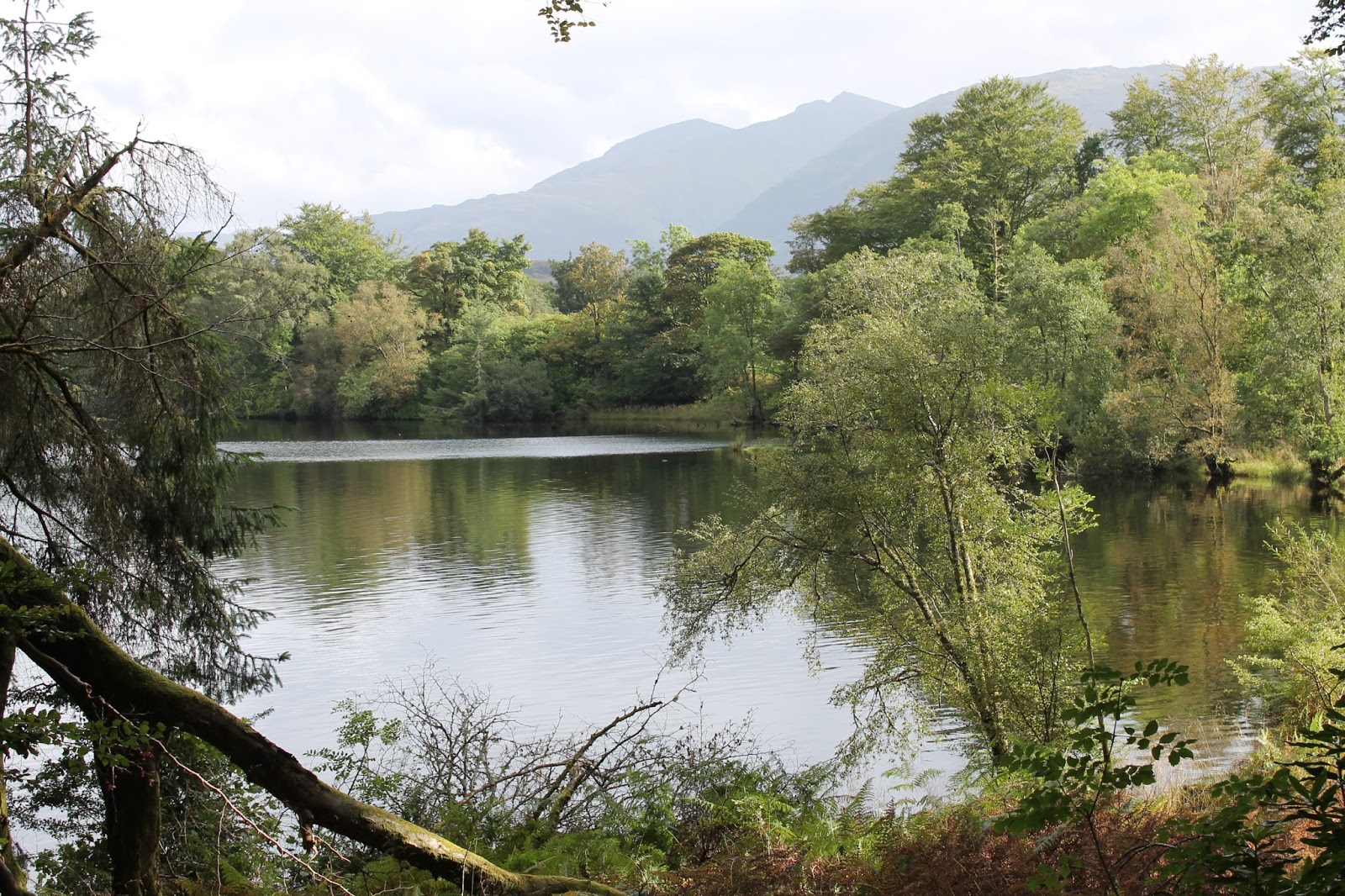
Disembarking at the Inn of Ardgour, we are indeed back in Morton's 1930's. When the noise of engines has subsided, there is nothing left but the breeze lifting across the crofts cluttering the bay. We stroll north past the parish church, designed and built by Thomas Telford, to take a sharp left turn up the lane and into the woods towards Lochan na h Eaglais, a perfect lake rimmed with silver.

If time forgot, it forgot this place. Here we dip down to the lakeside to sit in silence. A carp plops beneath overhanging branches and finches nibble the seeds of reeds. Otherwise, it is totally still -even the breeze that blew on Linnhe has evapourated in stillness.


The track takes us round to the crofting community of Clovullin and its village shop where a purchase, however small, must be made. From there, the road leads back to Corran lighthouse and the ferry home.


Two days seep into four before we resume Morton's route. Leaving Bunree, we travel north to Fort William, stopping not for the ceilidh but for provisions and fuel at Morrisons; and at Invergarry, we head west on the A87 past Loch Garry towards Lochs Layne and Cluanie - eventually to reach Shiel Bridge and Loch Duich where the leaves are turning 'blood-red and plum-yellow'.

On our route we meet again with H V Morton at chapter 7 section 3 of 'In Scotland Again'. The road, running alongside 'the roof of the highlands' is a delight, with mile after mile of wilderness tamed only by the Cluani Inn.

Beyond at Mam Rattachan before Glenelg, Morton observed 'As the light was drawn from the sky the mountains became grape-blue. Grey mists crept through the valleys; dark mists were hung from gorge to gorge high up in the wilderness of the hills. Above, the first star burned; and the mountains settled into silence and the dark'. 

We are on 'the road to the isles' and our way to Morvich.

In Scotland Again - Morvich, Kyle of Lochalsh, the Isle of Skye and Talisker: Episode 5

Morvich camping site lies to the east of the A87 in a drowsy, sunlit valley by the river Croe, peering up to Dorusaduain and overlooked by Lienassie.

This is yet another place of joy, back from the loch, but enjoying long views towards Duich.

Here, we caught up again with H V Morton on his 1933 trip, and had hoped to meet his friend Sir John (or his heirs). They clearly had already departed up the valley, so as 'In Scotland Again' at chapter 7 section 6, we decided to venture towards Beinn Fhada in search of our own Red Deer, armed in our case only with a camera.

The walk leaves Morvich towards Loch Duich, but turns sharply north to cross the Croe as if heading on the back route to the A87, then turning east passing the bed and breakfast lodge up the valley into the forest and the hills.


Chapter 7 contains one of Morton's reddish-brown sepia prints. A glance will tell you that, on our way, we found the same herd, spooked as we know by Sir John's sheep, and now gathered attentively below the trees on the other side of the valley awaiting our photo. 
The return route of the walk takes you down from the forest, crossing Abhiann Chonaig at the little footbridge constructed by the Royal Engineers, and back through the fells.

The walk is one of magic. Take a flask, a sandwich, a mat and binoculars. Climb the slope, sit in the bracken and heather and listen to the wind. Then look out for the eagle.

Skye bridge rises from Dornie on Loch Long, just to the north of Eilean Donan Castle. At this point we again leave 'In Scotland Again' to join H V Morton three years earlier in 1929 in chapter nine of 'In Search of Scotland'. You will recall from blog 2 that Robbie of Ayr had tempted me with Talisker, the same as shared with the Highlander Cameron (chapter 10 section 5 of 'In Search of Scotland'). Morton, by his own account, must have acquired his Talisker whilst on Skye as he reported it to be 'that remarkable drink which is made in the Isle of Skye and can be obtained even in its birthplace only with difficulty'

And so to Skye - for Talisker. H V Morton left from Mallaig to the south , taking the 'Stornoway' boat up the Sound of Sleat to Kyle of Lochalsh, where the ferry tied up 'to a a wooden jetty covered with pink sea-anemones', and he transferred to the Skye paddle steamer for destination Portree.

'To me it is pure romance. Some stray old wind from Culloden blew, I think, into my nursery when I was a child, for almost the first stories I heard were stories of Skye and of a brown-eyed prince hiding in a cave'....a place 'shrouded in the splendour of a lost cause'.'The sound of it is like a sword going home into its scabbard'.

But where the ferry? No swishing of a paddle steamer. Ahead the Skye bridge rises, then falls onto Skye, and in but two minutes we have arrived at Kyleakin. 

The road from here to Portree is quick, with none of the highland single track. It is made for trucks, buses and campers. Whilst it coils along the north east coast, the island's mountains remains totally unaffected by it. Dark and brooding, they give a feeling of hopelessness, not bleak, but simply ominous. We leave the A87 at Sligachan, heading west and inland on the A683 to Carbost and the distillery. Park beyond the factory to the right down towards the loch, and once equipped with your bottle of Talisker, why not ascend the hill beyond the distillery to lunch at 'The Oyster Shed'. First appearance is of a seafood farm shop - with a fish van outside. Be not fooled! This is the most perfect place to order and eat the widest range of locally sourced fish - especially shell fish, lobster, crab, prawns and scallops. Place your order at the shop counter and wait for your number to be called. Then head round the side to 'the shed' - an open fronted communal eatery with panoramic views over Skye - to devour your choice. The fish is so fresh you can almost feel it breathe. Flavour-packed and perfectly cooked, this provides a true taste of the isle. Take a side order of chips - now this is how chips should taste - and maybe crack open that bottle of Port Ruighe that you have just bought. 

Unlike Morton, who spent time at Portree, packing by candle-light and leaving 'to go down to the jetty where the 'Glencoe' lies, her riding-lights growing pale in the grey dawn', we leave in the evening, crossing the Skye bridge as the sun sets, and the gloom gathers. 

Tomorrow we will head out to Kinlochewe. 
Thanks to the Herald Scotalnd for the pic


In Scotland Again - Kinlochewe and Achiltibue: Episode 6 - final

Leaving Morvich by the back road, we catch the A87 west bound towards Eilean Donan Castle crossing Loch Long at Dornie. At Auchtertyre we branch north on the A890 heading for Achmore and Stromeferry. The road then hugs the loch side until you reach Achintee. From there, the A890 rises north east to Achnasheen, with a west spur on the A832 to Kinlochewe.

Our H V Morton friends will recall that, 'In Scotland Again' Henry headed east to Inverness, and in his less adventurous first journey 'In Search of Scotland', he descended from Fort Augustus to Fort William before venturing out to the western coast and to Skye. Times were different in 1933, and unless roads led to ferries, there was little point in pursuing them to the handful of crofts at the road end.

So we are leaving Morton to his inland journey. But we will retain his spirit of travel, to observe his Scottish wilderness through 21st century eyes; and just as he left his bull-nosed Morris behind, will leave the Auto Trail to walk and share the special Allt a' Chuirn path towards A'Chreag Dhubh.

We camp at Kinlochewe, a gentle site that rests below the Beinn Eighe National Nature Reserve. Our pitch collects the stream's gentle gurgle. After the mountain roads and tight bends, here is an oasis of calm. Even the nearby reserve has a soft, forested aspect to it with quiet walks on zig-zag stoned paths to the visitor's centre.


Just round from the site on the Torridon Road, Kinlochewe old village hall had probably seen better days before Lis Broome and her pose of helpers arrived to rescue the corrugated iron shed from the scrapman and turn it into The Whistle Stop Café, a vernacular place with oodles of charm and even better food. We visit before taking to the hills, and we are not alone.

Of the many Highland delights, The Whistle Stop Café's must rate as the best big breakfast. Joining Tom and Wendy, two young and intrepid walkers who were to cross the 1010 metres of Beinn Eighe and travel through 20 miles of heather tracks, Stephanie and I hunker down to the feast. This is the meal about which Morton dreamed in chapter 1 section 5 of 'In Scotland Again'.

Our journey is less ambitious. We aimed to walk the Allt a' Chuirn path west from the reserve towards the rugged, rocky Beinn Eighe, rising evenly by tracking the stream that cascades down to the A' Ghairbhe fed from Loch Clair. 


This is a truly magical walk, suitable for the averagely fit walker with three hours or so to spare. If the weather is kind, it is not to be taken at a trot, but savoured slowly with rests in the heather and long views through the valley.

 At the head of the valley where it departs into open, rugged terrain, stop at the waterfall. If the day is hot, drop down to the pool and bathe tired feet. We return down the valley in late afternoon sunshine. There is a sadness about leaving the solitude of the fells for the populated village below, but solace in anticipation of our barbecued 'born in Scotland', 'reared in Scotland', ear-tagged rib eye steak, pre-ordered from Allan at Kenneth Morrison, the camp site's visiting butcher (01445712485). 

Two days later, we head out for our final destination, Achiltibue, or more precisely, Port a Bhaigh campsite at Altandhu.


For Port A Bhaigh you must leave the A835 south of Drumrunie turning sharply out to the west 12 miles on on the narrowest single track road. The unnamed road traverses the north side of small lochs giving views into rugged low lying West Highland countryside. A measure of the terrain - you will need 45 minutes to complete the 12 miles, but using the passing places for moments to collect, we feel the journey as part of the experience. Port A Bhaigh campsite sits on a small bay, protected to the west by Isle Ristol and Eilean Mulagrach, the first of the Summer Islands, their low turf and heather clad moorland rimmed by cream rock shores.

The view is ‘heart-felt’ rather than breath-taking, but it has an intimacy that says you belong here. Ascend the hill to the owner’s pub. With friendly bar and dining room serving snacks and main evening meals, it has a convivial atmosphere. Make the most of it for, to the north, the nearest next pub is in Iceland. Walk the road to Reiff, offering headland views from the coastal path beyond, or hire kayaks for an escorted trip around the islands.


Henry Vollam Morton is still travelling as we return down to Inverness.
Like him, we found that the Highlands seeps into your soul. Gone, or rare, the Gaelic - no more the wood smoked hotel lounges with visiting 
salesmen and khaki-clad maidens. The ferries now pull with diesel engines rather than paddles. 

But the mountains remain solid and permanent, and the Golden Eagle still soars above.