Campervan Inventory


They arrive on site; perhaps with levelling blocks, a mains cable to the electric point, occasionally a waste water carrier, and maybe - if the weather is right - the roll out awning. The motorhome is then done. Its occupants retreat inside for tea, emerging later to walk the dog, or cooler nights to fit insulated screens.

What goes on inside? And more to the point of this blog, what is it that have the owners brought with them? 

Readers will recollect my earlier blog dealing with payload, and recall that our camper's load can be important, especially when travelling abroad. So now is a good time to review what we carry - and why. Of course, the content of our motorhome is a matter of choice, activity and taste, so this blog will hardly be definitive. But it may get you thinking about what you take with you, what you leave behind, and suggest some items to acquire.

We will start with the essentials for all motorhomers, whenever or wherever you travel.

The first - is water.
Motorhome manufacturers boast about the size of their water tanks, perhaps rightly for travellers who free-camp for days or weeks on end. Our water supply is key to many aspects of modern motorhome life,  not just for cleaning teeth. Save for the large trucks, few systems require water for heating, but with ever-expanding washrooms and well-equipped kitchens, the requirement for a good supply becomes essential.

One litre of water weighs one kilo - not by accident (the specific density of water = 1000kg/m3) - and that is almost a third more than gasoline. A full 100l tank adds 100kg to your vehicle, effectively undoing all of the manufacturer's tricks to reduce its weight, and often halving your payload. So this is one good reason why, when travelling, Stephanie and I don't carry a tank full, choosing to fill up on site; and why on leaving we drain all but 20 litres - hence the two taps on modern motorhomes. Clearly,  it makes conservation sense to calculate filling time against the length of your stay so that you don't wate time and water.

With this in mind, in addition to a flat-fold hose together with a combinationn of tap attachments, our first tip is to carry a shortened flexible funnel (3.49 on Ebay), together with an empty 10l clear camping canister (3.79 on Ebay), both of which of minimal weight.

Second - food and refreshment
I suspect that many motorhomes are filled with tins and packages. Stephanie and I spend substantial time travelling in the Scottish Highlands, and even 8,000 miles to Argentina, but rarely too distant from a shop. When away we are keen to try the local produce, with three benefits - the chance to try something new, to meet local people, and to reduce the van's travelling weight. For special items that may not be sourced locally, look to your packaging, and reduce this with plastic containers - ideal for storeage, convenience, and weight.

Third - clothing
Like many experienced motorhomers, Stephanie and I (in addition to our tango wardrobe) have evolved our 'motorhome wardrobe'. By necessity, this is seasonal, with both 'winter' and 'summer' clothes' which we switch as the season progresses. Even when wild camping, there comes a time when the launderette, or camp site laundry beckons - so why equip with too much? Think layers, and pack the staples - fleece, easy wash trousers, waterproof, hat, gloves, strong shoes, small rucksack, and a comfortable change for evenings in the van. 


Fourth - motorhome specific kit
There are some items that all motorhomers should acquire before their first journey. Here is our selection:

Levelling blocks. Levelling a motorhome is not a luxury - it is essential if you are not going to 'live on a hill', always tackling a slope. Even Caravan and Motorhome Club premier sites require these; and for wild camping they are essential. For historic reasons, I carry four - two Milenco Quattros, and two small Fiamma light weight. The former are heavy, but robust, and give a high level of elevation on uneven ground. The latter are convenient for those occasions when you simply need minor adjustment. To remove the guesswork add a Milenco superlevel indicator. 

Mud mats. If your motorhome is on a Fiat, Peugeot or Citroen chassis it will be front wheel drive, and mud mats will be essential on grass after rain, whatever the slope. These are cheap to acquire (or make from bread crates) and are light to carry. Do not leave home without a pair. Team them with a light weight nylon tow rope with snap-ring, which we store accessibly with our warning triangle and wheel jack.

Insulated screens. Unusually these find their way into the 'essential kit' list. For Stephanie and I, they have more to do with condensation than heat. They retain a lot more heat for winter camping, and reflect strong sunshine, making your motorhome more comfortable whatever the weather. They also provide an extra layer of privacy. But it is in relation to windscreen condensation that they come into their own, effectively eliminating the problem when living in a van. We recommend Taylormade screen covers in the long fitting, as these cover both screen and bonnet ventilators, as well as providing an easy fold-down section to admit daylight. If considering winter camping, why not buy a bonnet cover at the same time - you will be surprised by the difference it makes.

Waste water carrier. Most motorhomes are equipped with an 80 litre + waste water tank, meaning that you can store grey water for several days. However, when not regularly drained, water in the grey tank becomes fetid, and that will explain the smells sometimes appearing in your motorhome. Relying on the onboard tank also means you will have to make regular journeys to a motorhome drainage point (if one is available). The simple answer is to carry a waste water carrier, allowing grey water to drain rather than collect in the onboard tank. A carrier also avoids the necessity of queueing for 'the long drain' at busy departure times. Is a carrier really an essential? Many are happy to do without, but having one smooths the way.


Outdoor seating and matting. Some motorhomers love their attached or drive-away awnings. However, they do come at a price - as to cost, weight, and time spent in putting them up.  If your motorhome comes with a roll-out awning you will have a simple alternative for quiet weather and avoid the problem of muddy shoes and boots in the van. The art is to make the most of this space. Stephanie and I recommend the acquisition of woven plastic matting, available at most motorhome or caravan dealers. Use it equally on grass (where it allows the grass to 'breathe') or hard standing (where draining is not a problem) . Ensure that you have a selection of metal pegs and a mallet to anchor your awning and mat. It is also wise to buy a roll of webbing to secure your awning for those times when gusts of wind may cause havoc. 

Most motorhomers also buy lightweight fold-away seating for outdoor use. Bear in mind if you have a folding table in the van, this can be used outdoors. If you don't have an outdoor electric point consider packing an extension lead, especially the type that provides three pin and USB points.

Heating: Your motorhome comes with an efficient heating system which should keep your van toasty even during winter use. But there are times when you may seek just that little bit extra. The Dimplex Coldwatcher MPX500 has a number of advantages. Position it in the cab area, either vertically or on its side, it is 500w rated, uses low power, thermostatically controlled, convector style it is silent, light to move and almost indestructible.

Tool kit. The 'garage' in some motorhomes resembles a veritable workshop with everything but a lathe and welder. For the purpose of this blog I advise a small collection of the following tools: variable-head screwdriver, pair of adjustable spanners, pliers, hammer, folding knife, zinc hose clips, plastic cable ties, bungee ties, strong cord, small 12v compressor, tyre pressure guage, heavy duty tape, spare fuses, WD40 or silicone spray, high viz jacket, protective gloves. Additionally, I store a torch and sheet of heavy plastic in case I need to slide beneath the van.

Medical kit. Whatever sort you carry, it must be accessible. Stephanie and I keep our kit in a shoebox beneath an interior seat that also has outside access. Here we have a selection of bandages, pasters, butterfly stitches, tape, scissors, plastic eyebath, small medical knife, antiseptic, pain relief and indigestion relief. 

Fire extiguisher. Manufacturers have made great strides in fireproofing motorhomes, but they are still a major fire hazard. It is for this reason that open pans should be attended, chip pans never used, and candles restricted to outdoor use. Modern motorhomes come with a fire extinguisher, which should be serviced periodically, and supported by a fire blanket. Bear in mind that should your motorhome catch fire, the only objective is to get out safely, rather than firefighting an existing blaze. Always ensure that your smoke and CO2 alarms are in working order.

Laundry kit. We tend to carry washing powder, hand washing soap, Vanish stain remover bar, small brush, window attaching clothes rail, light line, and pegs, all of which is stored in a small plastic wash bucket. Most commercial machines are coin operated, so it is wise to store some small change for this purpose and for parking charges.

Van care. Here we are addressing that which is essential whilst travelling.  Others may pack comprehensive van cleaning equipment, but my outdoor equipment comprises simply a wash cloth, retired wiper blade and small plastic bucket (which doubles for BBQ cleaning). For the interior, consider multi-surface and antisceptic sprays, J cloths, toilet fluid, dustpan and stiff brush.


Now we move on to the variable content of your van. Here, as with the list of items above, weight is an important consideration, so Stephanie and I have made evident compromises. The art is to get light-weight kit, and add back luxury items if your payload allows.

Let us start with the kitchen area. Most motorhomers use a low wattage 1 litre 240v electric kettle with automatic cut-off. Bear in mind that whatever size you need, it will take up valuable work surface. Some make do with a small whistling kettle for the gas hob. Stephanie and I carry both, using the quicker, safer, cheaper electric kettle when on hook-up. With this we use a Cafe Ole infuser teapot, six cup Bialetti coffee maker, and insulated mugs if you like your drinks hot. For cold drinks we have gravitated to superb replica plastic glasses both for Malbec and champagne. Not only has this choice reduced van weight, but the stress of breakages, especially in outdoor use. 

The late summer garden shop sales provide a profusion of melamine tableware which is ideal for both inside and outside your motorhome. Here weight is key, for you will spend time carrying, washing and storing your crockery. As an indulgence, Stephanie and I have two china plates - which frankly we prefer. For cutlery, select the basics and keep it in the van. This avoids the unwanted moment when you have the wine bottle, but not the corkscrew!

Pans must be simple, light and versatile. We advise a three tower pan/steamer set, to which we have added a frying pan, a small milk pan, and baking tray. Should you have a microwave, don't forget to purchase some non-metalic containers which may double for fridge storage. On the topic of storage, source pierced plastic boxes, which together with bubble wrap, makes accessing 'rattly things' so simple.

The bedroom. With our Auto Trail Tracker FB, we have a queen size rear bed, ideal for couples travelling alone. On this we have placed a Duvalay zipped topper which the manufacturers will cut  to measure. For bedding, we use a fitted bottom sheet topped with duvet and throw. The art here is simplicity, and with access to site laundry facilities, there is rarely need to carry additional bedding.

The bathroom. As with our bedding, we have purchased bespoke camper towels which, whilst not permanently stored in the van, are restricted to van use. Remember that motorhoming does not have to be basic, and a little luxury is sometimes appropriate, so buy quality. It is also the one occasion where others will scrutinise your towels whilst in transit to the shower block. The bathroom is also our place of choice to store cleaning materials, keeping them accessible where they are really needed.

So far, we have covered 'main kit' rather than luxuries. Those with pets will have further calls on their payload. Sports people will have even more kit, especially if you carry bicycles on a rear rack.  Bear in mind that unless your van has a greater than 3500kg gross mass, you are likely to exceed your MTPLM payload. But with clever sourcing and strict policies, you should stay legal and safe. Best of luck!


Exploring the cosmos


Whilst our September Scottish travel with H V Morton was not our last Tracker outing (having since 'tracked' the Yorkshire Dales), it will be the last posting until April 2017.

Why? Because from early December until April we will be on an altogether different journey - to dance Argentine tango in Buenos Aires.

If your interest is not simply motorhomes, but extends to 'out of the comfort zone'  travel, do follow our progress here http://stephentwist.blogspot.co.uk/. But don't forget to return in April to read more Tracker travels, including our special feature on the Twinwood Festival later in the year.

In Scotland Again: Episode 1

On 26 October 1933 - nearly 83 years ago at the age of 41, Henry Vollam Morton, journalist with the Daily Express and Britain's foremost and prodigious travel writer, left his home in a London square to undertake his second motoring trip to Scotland. He titled his account 'In Scotland Again'.

In his earlier1929 trip, described by him in his book 'In Search of Scotland', Morton had travelled a route from Jedburgh to Edinburgh, St Andrews and Aberdeen, topped Elgin and Inverness, cutting down to Fort William and on to Skye, returning through Glasgow, Ayr and Dumfries. His second trip in 1933 took him clockwise from Dumfries, Galloway, Arran, Mull, Fort William, Inverness, then right the way across the north coast of Scotland to Wick, returning via Inverness, Pitlochry, Aberdeen, Dundee, Stirling and Edinburgh - to Carter Bar and the border.

Reading 'In Search of England' back in the early 1980's, I little realised that I would attempt to recreate at least part of Morton's travels. Last year in a little bookshop in Wigtown Dumfries, I rediscovered H V Morton, hidden amongst dusty books on the bottom shelf. And so my love affair with Morton was rekindled.

Those who know me will know that I have some advantages over Henry Morton: a 200 mile start - leaving Darlington in Co Durham, rather than a Queen Anne square in central London; a network of fast roads leading to the Highlands; and rather than a pre-war Morris 'small but experienced motor car', a 2015 Auto Trail Tracker motorhome.

Given those advantages, my account here is set against the penalties of twenty first century life - the rash of civilisation, the huge population increase, the ubiquitous internal combustion engine, a loss of community, and with them, the death of an era.

It is Thursday 1 September 2016. Stephanie (in 'khaki shorts') and I leave Darlington in the motorhome, equipped with waterproofs, walking boots, a map and H V Morton. This time, he will be a passenger, to brave our company, tucked in the book rack . We head not north, but strike out west on the A66 route via Bowes and Brough to Westmorland and Cumberland. Our aim is the M6 at Penrith, and on to Carlisle - where Morton's second adventure starts.

Carlisle, once a key town on the road to the western Highlands, now lies shortly to the west of the motorway, avoiding Scottish travellers. Within moments the signs appear, then recede in the rear view mirrors. and so we progress towards the A74M. Stephanie looks wistfully at the signs for Gretna, and I, remembering Earl Edward Gibbon Wakefield, cough self-consciously, taking instead the A75 Dumfries road into 'the strong land of Galloway'. Between Gatehouse of Fleet and Creetown, the road hugs the coast and the joy of this still undiscovered 'heavenly country' of Scotland emerges.

To the west, Wigtownshire - the peninsula that descends south to the Isle of Whithorn, is an area of considerable delight. Leaving the A75 by Newton Stewart, the A714 heads down through Wigtown towards Garlieston. Here the strong land softens as one skirts the bay projecting to the Irish Sea. It is not yet the land that time forgot, but rests a good couple of decades behind middle England. Morton described it as 'infinitely remote', and save for the House Martins, Sand Martins, Swallows and Swifts that hurtle overhead, and the speeding local bus that races the clouds along narrow but straight roads, the pace of life slows.

Wigtown, now the book town of Scotland, is perhaps less solemn than that found by Morton. Almost every shop, café and pub contains books to buy or simply to borrow. It still boasts its huge square, leading down, passing the church, to the dead harbour below where in 1685 Wigtown Martyr Margaret Wilson was drowned. Today, close boarded walkways lead out into the fen to the stone to which she was chained and left for the tide. Perhaps here Morton's solemnity returns in the desolation of the marsh and the paining memory of lost souls.

The Mull of Galloway is still the 'Land's End of Scotland'. It is here at New England Bay, south of the Sands of Luce, that we camp for our first night. Slipping from the road, the site lies against the bay. We pitch short of the gorse covered rocks and dunes. This is a land of seals and Osprey. Linnets and Goldfinches search for seeds and Whitethoats dart for cover. As the sun sinks behind us, the lights of a tethered tanker flicker out in the bay. Our Scottish return with Henry, has begun.


Garlieston - photo by Stephanie Rose


With thanks to H V Morton Society and Niall Taylor for reference material.


In Scotland Again - Galloway to Ayr: Episode 2

In 1933 Henry Vollam Morton was in no rush to reach the Scottish Highlands, and of twelve chapters of 'In Scotland Again' the first four tell of his travels in the border counties of Dumfries and Galloway. And so it was with our first four nights, camped out at in the peninsula at New England Bay.

It is here that we walk the dunes, lying back in the long drying grass to watch seals surfacing and fishing, creating small black pools with watchful eyes. Guillemots and Razorbills track the coast. In the early autumn evenings we hear the gentle sound of breakers riding the rocks at high tide.
Inland walks take us through overhung tracks and deep-sided lanes giving panoramic views as they slope to the bay, and beyond to Port William. From the Mull on a good day you see the twinkle of car windscreens on the Northern Irish Ballywalter coast.


On leaving Galloway, Henry Morton headed for Arran. We, on the other hand, are diverting, drawn by chapter 12 section 5 of 'In Search of Scotland', to the coastal town of Ayr. Our's is a 'haste for the Highlands', and we need to stock up one final time before crossing Erskine bridge and heading up by Loch Lomond to the Killin Falls of Dochart.

Ayr is always a surprise. The town sits comfortably on the river as it enters the Firth of Clyde. It retains the feel of the old seaside town - ageing splendour of Scottish architecture meets modern market town, and neither seem to be winning. We pitch on the outskirts and walk the riverside to town, the Ayr smooth as a boating lake and overhung with willows. The sun has brought out the walkers, joggers and lovers. A series of three bridges, two for pedestrians, invite entry to the town on the south bank.

Now is the moment to relish  Ayr's highlight. We stroll to 3 Sandgate, the home of Robbies Drams. Established in 1983, this is a whisky paradise. The bell tinkles as we enter. Ahead, an old assistant, presumably here since the shop first opened, smiles. It is the smile of a man who has something to sell, but all the time and patience in the world to sell it. This may indeed be the founder, Robbie Russell.

H V Morton in chapter 10 section 5 of 'In Search of Scotland' introduced me to both 'the Highlander Campbell' and the Skye whisky 'Talisker'. My untested tastes of whisky do not extend to the old and expensive vintage single malts, but the Talisker Port Ruighe whetted my appetite for another dram. We walk by the shelves of Scotch seeking something different - maybe Compton Mackenzie's 'Stalker's Joy', rescued from the S.S. Cabinet Minister at Little Todday; but settling eventually on a double matured Cardhu single malt.

With the sensation of a fisherman with a great catch, we return to the Tracker. Stephanie repeats Morton's words teasingly "Ye don't mean to open the bottle? It's a shame to waste it; but man, its a grand whisky!"  She is right, now is not the time and place to crack open the Cardhu. Like Morton's Talisker, a 'Tumbler or twa o'  Toddy' will wait for thunder in Glencoe.

In the morning, the Tracker heads for the Trossachs, Loch Lomond and Crianlarich. Our destination is Maragowan at Killin, right at the head of Loch Tay.

To reach Crianlarich, the A82 skirts the west side of Loch Lomond. The first 15 miles to Tarbet, where the A83 turns west to Loch Long, the road is fine, with 'bonnie banks'. From Tarbet to the head of the loch, what can I say? For car drivers, the route is negotiable with care. For motorhomes it is a nightmare - sandwiched between the loch shoreline and the mountains. 7.2 metres width of horror with rocks and walls to one side and water to the other is not condusive to gentle motoring. In chapter 10 section 7 Morton's gaze along 'twenty four miles in exquisite beauty' was presumable to the lake side with an empty road ahead. On his return in 1933, chapter 5 section 8 of 'In Scotland Again' reveals that he took the wise alternative and branched off west on the A83 to Glenroe, Inveraray and on to Oban. This was the one occasion when I envied his choice of road.

Leaving the A82 at Crianlarich, we turned east on the A85 to Ardchyle, and beyond the A827 to Killin.

The road lies just to the south of the river Dochart, slim and fast, then widening suddenly to the falls. At Killin, the road crosses the falls, giving a spectacular view.


The river cascades towards the loch in torrents between large flat slabs of rock, accessible from the road, giving a spectacular natural show. Nearby, Breadabane Folklore Centre (run by village volunteers), is a working mill on two floors, providing local information, crafts, cards, maps and donated items of furniture and clothing.

Eating out in Killin should not be missed, with 'hunger and anticipation' taking us to  The Courie Inn. Here is served locally produced and wholesome food cooked to perfection. This, our second visit rivaled the first. Stephanie and I skipped the Haggis Bon Bons (described as 'fabulous') simply because we knew the portion sizes of the main dishes, and ordered Solway mussels as a first course. Delicious, served without shells in a parsley, cream and garlic sauce with warm, crisp bread. For main dishes we ordered lamb and beef, both subtle and cooked with devotion. The lamb in particular was impressive, crisp on the outside and melting within, served on a bed of potato with roasted vegetables. We liked the vernacular 'feel and flavour' of the food - prepared without pretension but with style and finesse. It was quintessentially Scottish in character.
And so to another night, this time with the sound of the river Lochay making its way to Loch Tay and the wind in the trees. Time for Cardhu.


In Scotland Again - Killin to Bunree: Episode 3


Those readers familiar with H V Morton's 'In Search of Scotland' and 'In Scotland Again' will already have issues with our route. We have not been strictly faithful to Morton's 1933 account and have slipped between his two journeys. Our trip has taken us to Ayr (as did Morton's in 1929) - and not to Arran. But that is how travel works, and I suspect, how occasionally, Morton too used his artistic licence.

However, we are to meet up again with him on the road to Fort William as we head for Bunree, between Onich and Corran on the A82, and this means that his bull-nosed Morris and my Auto Trail Tracker can pass each other in the heart of Glencoe (chapter 10 section 2 of 'In Search of Scotland').

We are already apprehensive, remembering Dicken's words, as quoted by Morton, from 'Foster's Life'  "anything so bleak and wild and mighty in its lonliness, as in the whole country, it is impossible to conceive. Glecoe itself is perfectly terrible. The pass is an awful place". 

Would Morton recognise today's Glencoe? He would continue to marvel at 'a landscape without mercy' - a land 'still dreaming of geological convulsions'. The mountains that border Glencoe remain ominous and overbearing. There is drama - simply from the inescapable landscape. But what of man's efforts to tame the journey? Morton would undoubtedly be saddened. Engineers have cured 'the worst road in Scotland' that 'winds its way through the solitude'; but with the cure, comes the crowd. Yes, the glen is busy as we journey on a September morning - still preserved and uninhabited, but with coaches (and motorhomes) delivering tourists rather than travellers. Morton's shepherd no longer walks his sheep in a 'grey wave over the grass on invisible feet', he rides an ATV. Enchanting Diana's no longer visit in breeches and dubbined boots, they are tamed in designer jeans and trainers as they inspect the glen from the viewing point. And sadly, despite Stephanie and I singing 'D'ye ken John Peel with his coat so gay' we fail to encounter the Highlander Campbell in Crianlarich, or on the mountain.

So we leave the glen behind and reach Loch Leven where the A82 swings to the west along its southern shore which will take us through North Ballachulish, on to Onich and Bunree at Loch Linhee.

Let us return promptly to chapter 6 section 3 of 'In Scotland Again' to rejoin Morton. 'Imaging dark mountains rising from a tidal loch, ridges of trees marching the hills like regiments, the mountains piling up in the distance towards the gloomy fastnesses of Glencoe and Lochaber, the whole scene mirrored in sleety-grey water ruffled at the edges by a fresh wind and swirling in a central channel with an incoming tide'. Like Morton, Stephanie and I have reached the Loch Leven crossing, and pause, looking for Morton's ferry boatman; but instead we see but an expanse of box bridge. The Highlands are surely tamed as 7 metres of motorhome hums across the loch on tarmac. Needless to say, we miss the ferryman's Ancient Mariner's eye and the Renfrewshire traveller. How times change.

To my knowledge, Morton never visited the lochside at Bunree. Had he done so, he would have experienced a true Scottish delight. This is to be our eighth night, and destined to be the start of a longer stay. A single red traffic light turns to green, and we thread our way along the approach road to Bunree site as it opens out into the glorious bay where Loch Linnhe narrows to the Corran crossing.


Our pitch is lochside. Now in spirit we can recreate a sense of Morton's Loch Leven crossing here on Linnhe. Our Auto Trail Tracker faces out to the bay, and sitting in gathering dusk we prepare to navigate out across the loch. The light dims. A single buoy blinks out towards Clovullin and the straits lighthouse spins a flash of warning to our starboard side.

Time to pull the blinds, to return to the Cardhu single malt, and to sleep.


In Scotland Again - Bunree, Loch Linnhe to Loch Duich and Morvich: Episode 4

Whilst HV Morton, on his 1933 trip, forges ahead in his bull-nosed Morris to Fort William and the Mod, we are resting back at Bunree, looking out over the bay at stunning sunsets. September has gathered pace, 'the Rowan berries are red as the blood in Glen Spean', and the bracken russet brown.

Henry Morton's observations of the drama of the Highlands is so real here. One moment huge grey clouds race from the west into the bay and rain lashes against the camper roof, the next, sun lights and warms the craggy landscape as 'a day of atonement'.

Today is one of the atoning days, and we thread our way to the Corran ferry, just under half a mile from the site. Taking the little track from the roadside path to the ferry point, we arrive just as the boat moors across the narrowest point of Loch Linnhe at Ardgour. As the cars and vans arrive to queue, we feel almost intrepid as free foot passengers, and are waved on first by the crew.


Take the high shelf on the boat to enjoy the view and feel the wind. The crossing takes but four minutes or so, departure and arrival assisted by hydraulics rather than 1930's rough ropes. But nevertheless, it is still a ritual. The cars are stacked so that barely a crisp packet could be placed between their bumpers. Drivers, new to the ferry, look anxious, whilst the regular travellers spin their vehicles into place. The doctor's Mercedes is given a place at the front for quick get-away, whilst butcher's van holds back to fill an awkward slot across the deck. Did a siren sound? Morning sunshine glints on a computer screen in the wheelhouse. We slip across the smooth loch.


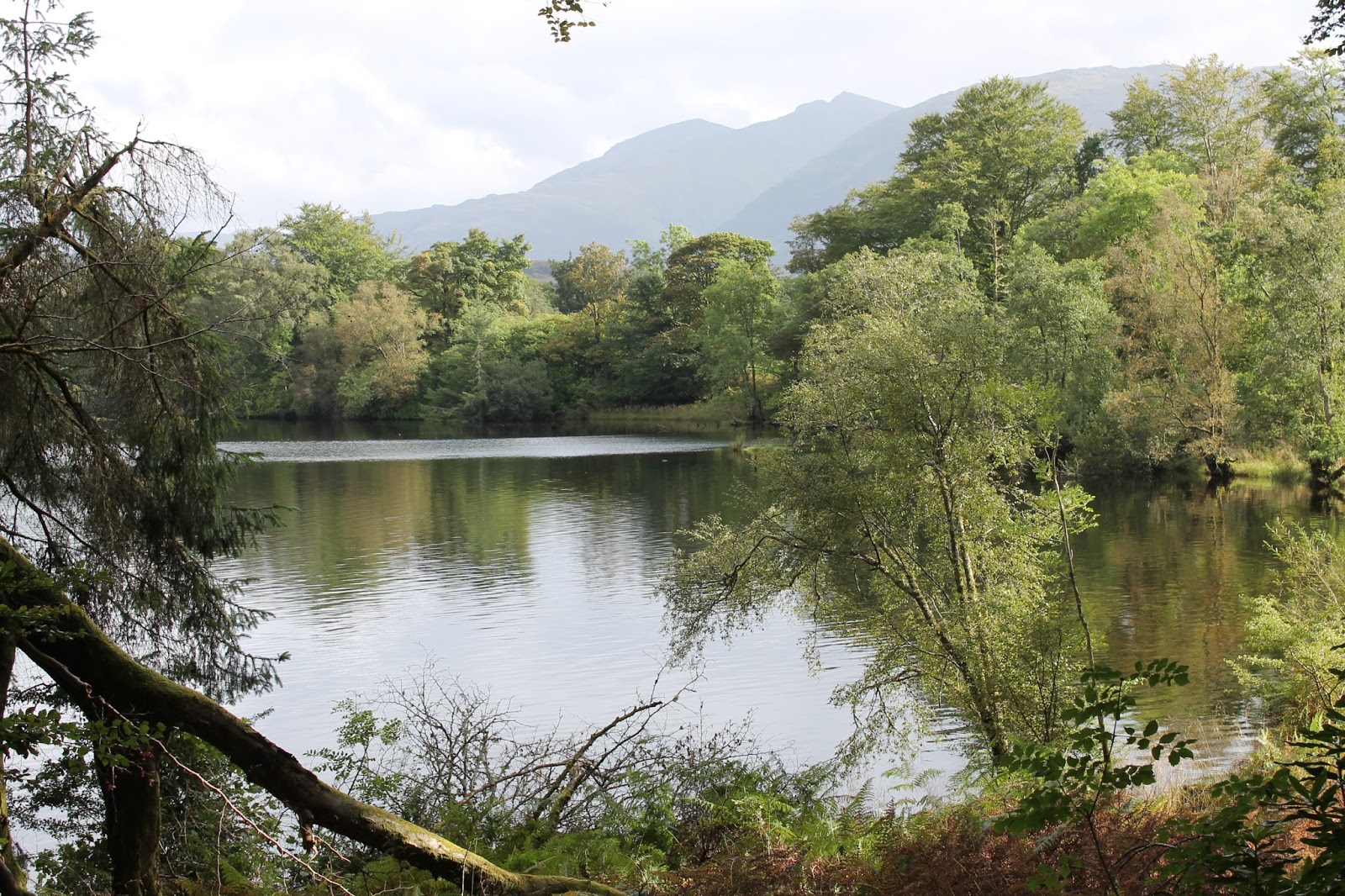
Disembarking at the Inn of Ardgour, we are indeed back in Morton's 1930's. When the noise of engines has subsided, there is nothing left but the breeze lifting across the crofts cluttering the bay. We stroll north past the parish church, designed and built by Thomas Telford, to take a sharp left turn up the lane and into the woods towards Lochan na h Eaglais, a perfect lake rimmed with silver.

If time forgot, it forgot this place. Here we dip down to the lakeside to sit in silence. A carp plops beneath overhanging branches and finches nibble the seeds of reeds. Otherwise, it is totally still -even the breeze that blew on Linnhe has evapourated in stillness.


The track takes us round to the crofting community of Clovullin and its village shop where a purchase, however small, must be made. From there, the road leads back to Corran lighthouse and the ferry home.


Two days seep into four before we resume Morton's route. Leaving Bunree, we travel north to Fort William, stopping not for the ceilidh but for provisions and fuel at Morrisons; and at Invergarry, we head west on the A87 past Loch Garry towards Lochs Layne and Cluanie - eventually to reach Shiel Bridge and Loch Duich where the leaves are turning 'blood-red and plum-yellow'.

On our route we meet again with H V Morton at chapter 7 section 3 of 'In Scotland Again'. The road, running alongside 'the roof of the highlands' is a delight, with mile after mile of wilderness tamed only by the Cluani Inn.

Beyond at Mam Rattachan before Glenelg, Morton observed 'As the light was drawn from the sky the mountains became grape-blue. Grey mists crept through the valleys; dark mists were hung from gorge to gorge high up in the wilderness of the hills. Above, the first star burned; and the mountains settled into silence and the dark'. 

We are on 'the road to the isles' and our way to Morvich.

In Scotland Again - Morvich, Kyle of Lochalsh, the Isle of Skye and Talisker: Episode 5

Morvich camping site lies to the east of the A87 in a drowsy, sunlit valley by the river Croe, peering up to Dorusaduain and overlooked by Lienassie.

This is yet another place of joy, back from the loch, but enjoying long views towards Duich.

Here, we caught up again with H V Morton on his 1933 trip, and had hoped to meet his friend Sir John (or his heirs). They clearly had already departed up the valley, so as 'In Scotland Again' at chapter 7 section 6, we decided to venture towards Beinn Fhada in search of our own Red Deer, armed in our case only with a camera.

The walk leaves Morvich towards Loch Duich, but turns sharply north to cross the Croe as if heading on the back route to the A87, then turning east passing the bed and breakfast lodge up the valley into the forest and the hills.


Chapter 7 contains one of Morton's reddish-brown sepia prints. A glance will tell you that, on our way, we found the same herd, spooked as we know by Sir John's sheep, and now gathered attentively below the trees on the other side of the valley awaiting our photo. 
The return route of the walk takes you down from the forest, crossing Abhiann Chonaig at the little footbridge constructed by the Royal Engineers, and back through the fells.

The walk is one of magic. Take a flask, a sandwich, a mat and binoculars. Climb the slope, sit in the bracken and heather and listen to the wind. Then look out for the eagle.

Skye bridge rises from Dornie on Loch Long, just to the north of Eilean Donan Castle. At this point we again leave 'In Scotland Again' to join H V Morton three years earlier in 1929 in chapter nine of 'In Search of Scotland'. You will recall from blog 2 that Robbie of Ayr had tempted me with Talisker, the same as shared with the Highlander Cameron (chapter 10 section 5 of 'In Search of Scotland'). Morton, by his own account, must have acquired his Talisker whilst on Skye as he reported it to be 'that remarkable drink which is made in the Isle of Skye and can be obtained even in its birthplace only with difficulty'

And so to Skye - for Talisker. H V Morton left from Mallaig to the south , taking the 'Stornoway' boat up the Sound of Sleat to Kyle of Lochalsh, where the ferry tied up 'to a a wooden jetty covered with pink sea-anemones', and he transferred to the Skye paddle steamer for destination Portree.

'To me it is pure romance. Some stray old wind from Culloden blew, I think, into my nursery when I was a child, for almost the first stories I heard were stories of Skye and of a brown-eyed prince hiding in a cave'....a place 'shrouded in the splendour of a lost cause'.'The sound of it is like a sword going home into its scabbard'.

But where the ferry? No swishing of a paddle steamer. Ahead the Skye bridge rises, then falls onto Skye, and in but two minutes we have arrived at Kyleakin. 

The road from here to Portree is quick, with none of the highland single track. It is made for trucks, buses and campers. Whilst it coils along the north east coast, the island's mountains remains totally unaffected by it. Dark and brooding, they give a feeling of hopelessness, not bleak, but simply ominous. We leave the A87 at Sligachan, heading west and inland on the A683 to Carbost and the distillery. Park beyond the factory to the right down towards the loch, and once equipped with your bottle of Talisker, why not ascend the hill beyond the distillery to lunch at 'The Oyster Shed'. First appearance is of a seafood farm shop - with a fish van outside. Be not fooled! This is the most perfect place to order and eat the widest range of locally sourced fish - especially shell fish, lobster, crab, prawns and scallops. Place your order at the shop counter and wait for your number to be called. Then head round the side to 'the shed' - an open fronted communal eatery with panoramic views over Skye - to devour your choice. The fish is so fresh you can almost feel it breathe. Flavour-packed and perfectly cooked, this provides a true taste of the isle. Take a side order of chips - now this is how chips should taste - and maybe crack open that bottle of Port Ruighe that you have just bought. 

Unlike Morton, who spent time at Portree, packing by candle-light and leaving 'to go down to the jetty where the 'Glencoe' lies, her riding-lights growing pale in the grey dawn', we leave in the evening, crossing the Skye bridge as the sun sets, and the gloom gathers. 

Tomorrow we will head out to Kinlochewe. 
Thanks to the Herald Scotalnd for the pic